


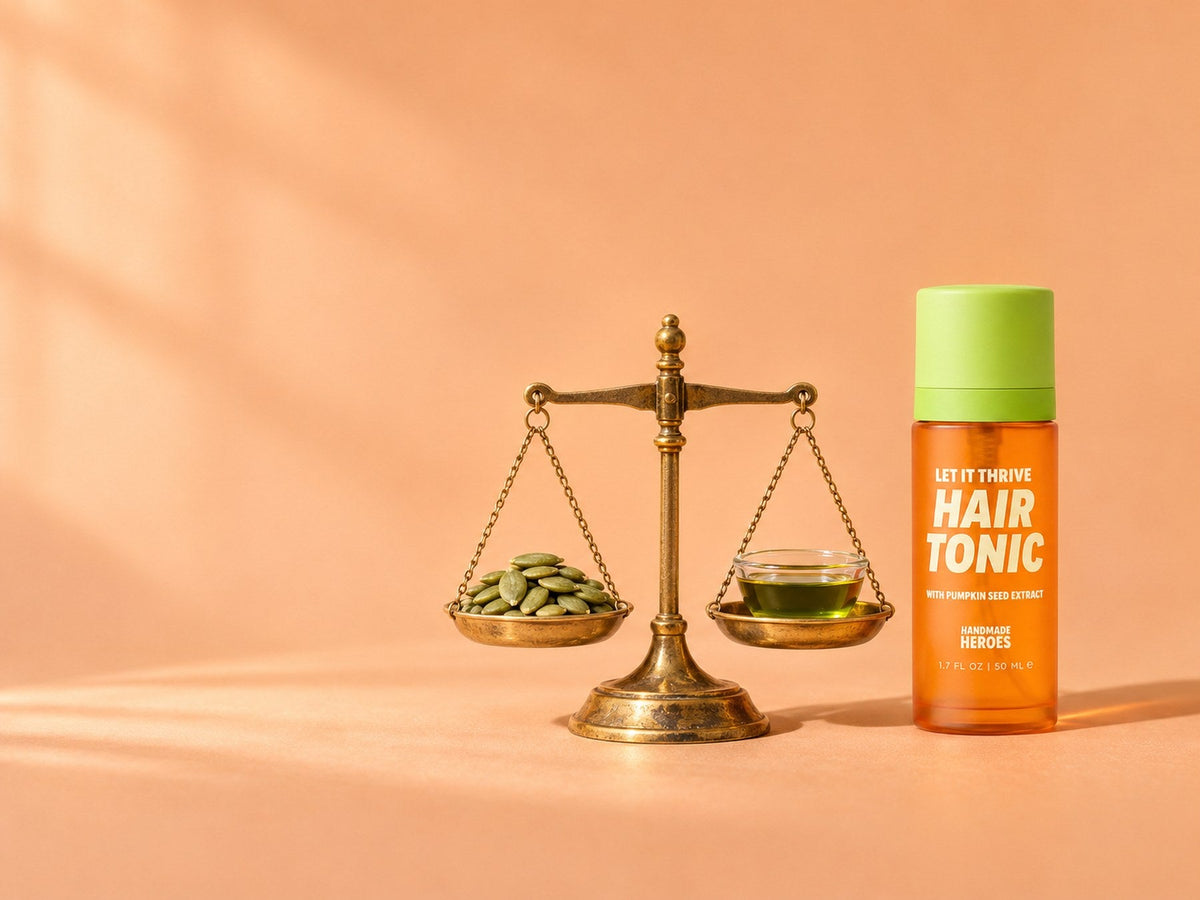
TL;DR: Pumpkin seed oil has real, if limited, research behind it. In a 2014 trial, 76 men taking pumpkin seed oil capsules saw hair count rise 40% vs. 10% on placebo over 24 weeks. In a small 2021 trial, 60 women applying pumpkin seed oil to the scalp for 3 months improved on several measures, in the same direction as 5% minoxidil foam. Promising, not proven. Here’s what each study does and doesn’t show, plus the easy daily habit that puts pumpkin seed extract on your scalp.
Pumpkin seed oil is quietly one of the more interesting botanical ingredients in scalp care — and unlike a lot of wellness trends, it has actual peer-reviewed research behind it. The catch: the best-known study involves swallowing capsules, not applying anything to your scalp, and the topical research is smaller. Let’s get into what the studies say and what you can reasonably expect.
This article is general information, not medical advice. For persistent, sudden, or patchy hair loss, please see a board-certified dermatologist.
The capsule trial everyone cites (Cho et al., 2014)
The most-cited study is a randomized, double-blind, placebo-controlled trial by Cho et al. (2014), published in Evidence-Based Complementary and Alternative Medicine. Seventy-six men with mild to moderate androgenetic alopecia (male pattern hair loss) took either 400 mg of pumpkin seed oil a day, as capsules, or a look-alike placebo for 24 weeks.
Results: hair count rose by an average of 40% in the pumpkin seed oil group versus 10% in the placebo group — a statistically significant difference. The men taking pumpkin seed oil also rated their improvement and satisfaction higher, and side effects were no different between the groups.
Important caveats to keep in mind:
- It was an oral study. Nobody put pumpkin seed oil on their scalp.
- It only included men with pattern hair loss, so the results don’t automatically apply to women or to other kinds of hair loss.
- The capsules were a branded product (Octa Sabal Plus), and the study was funded by the company that supplied them (Cho et al., 2014).
- A published comment pointed out that results for the front of the scalp weren’t reported, and argued for follow-up of at least a year (Verma, 2015).
- It’s a single trial. It needs replicating at a larger scale before anyone draws firm conclusions.
The topical trial in women (Ibrahim et al., 2021)
This is the study that matters most if you’re putting pumpkin seed oil on your scalp rather than swallowing it. In a randomized comparative trial published in the Journal of Cosmetic Dermatology, Ibrahim et al. (2021) assigned 60 women with female pattern hair loss to either topical pumpkin seed oil (30 women) or 5% minoxidil foam (30 women) for 3 months. Their scalps were checked with dermoscopy at the start, at six weeks and at three months.
In the pumpkin seed oil group, hair shaft diversity (the mix of thick and thin hairs that’s typical of pattern thinning) dropped from 30.5% to 24.0%, and fine vellus hairs fell. The count of new upright hairs also rose. The minoxidil group also improved on hair shaft diversity and vellus hairs. The authors concluded pumpkin seed oil shows a “promising potential role” for female pattern hair loss.
The honest read:
- It’s small (60 women) and short (3 months).
- There was no placebo group. Each group was compared with its own starting point, so it can’t prove pumpkin seed oil works as well as minoxidil, only that both groups moved in the same direction.
- The published summary doesn’t describe blinding, or the exact preparation and amount of oil used.
So it’s encouraging, and it’s the strongest topical human evidence so far, but it’s a first step, not a verdict.
What about lab and animal studies?
A 2022 study in Pharmaceuticals by Teeranachaideekul et al. tackled a practical problem: getting pumpkin seed oil into the skin and hair follicles. The team packaged the oil in niosomes (tiny lipid carriers) and ran a series of tests:
- Lab tests: the formulation inhibited 5α-reductase (the enzyme that makes DHT) and an inflammatory signal (IL-6) in cell cultures.
- On people: 42 adults (20 men, 22 women) used a scalp serum containing 5% pumpkin-seed-oil niosomes twice a day for 8 weeks. Hair fall in a 60-second comb test dropped by about 44% compared with their own starting point. In a smaller group of eight, the ratio of growing to resting hairs rose 1.4-fold.
The caveat: there was no placebo group, so we can’t separate the serum’s effect from everything else that changes over 8 weeks (seasons included).
In mice, Hajhashemi et al. (2019) found that 10% topical pumpkin seed oil partly reversed testosterone’s hair-suppressing effect, raising the share of hair follicles in the growth phase. It didn’t match 2% minoxidil. Animal results are useful clues, not proof for humans.
Why the mechanism makes sense (and where it’s still a guess)
Pumpkin seed oil is rich in fatty acids, tocopherols (vitamin E) and plant sterols (Teeranachaideekul et al., 2022; Hajhashemi et al., 2019). Those sterols are the leading theory: they may inhibit 5α-reductase, the same pathway some prescription hair loss treatments target.
- The evidence for that idea comes from lab and animal work.
- It hasn’t been confirmed in people. The Cho trial didn’t measure DHT levels, and its authors say they couldn’t explain exactly how pumpkin seed oil worked (Cho et al., 2014).
- The fatty acids also make it a nourishing, conditioning oil for the scalp in its own right.
What pumpkin seed oil is not
It is not a cure or treatment for hair loss. It’s a cosmetic conditioning ingredient with a promising, still-developing evidence base. If you’re dealing with significant shedding, patchy loss or sudden changes in hair density, the right first move is a dermatologist, not a serum. Not sure which you’re dealing with? Our guide to hair shedding vs. hair loss is a good place to start.
The 10-second daily habit that puts the research to work
You don’t need to swallow capsules for 24 weeks to bring pumpkin seed into your routine — you need about 10 seconds and a light hand. A little daily attention to your scalp is the one move that’s completely in your control, and doing something feels a whole lot better than doing nothing.
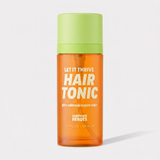
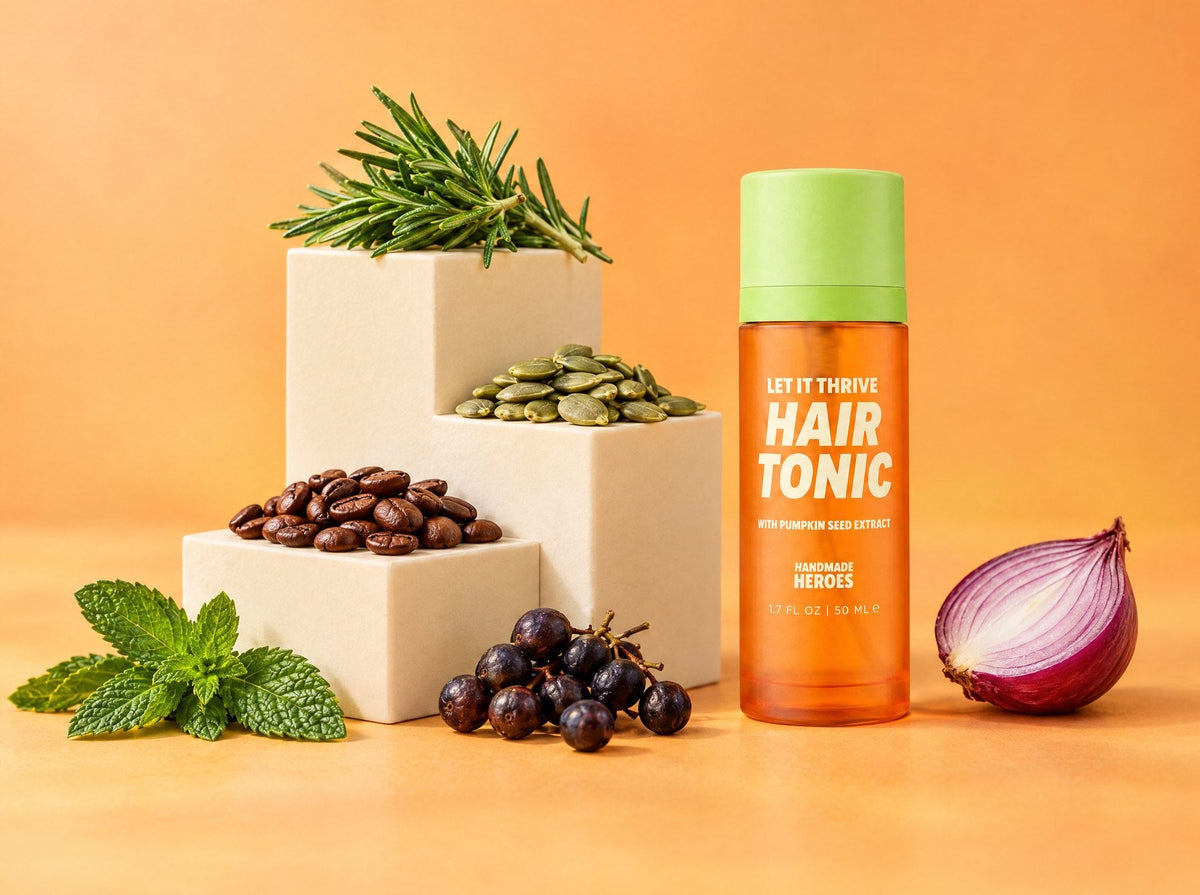
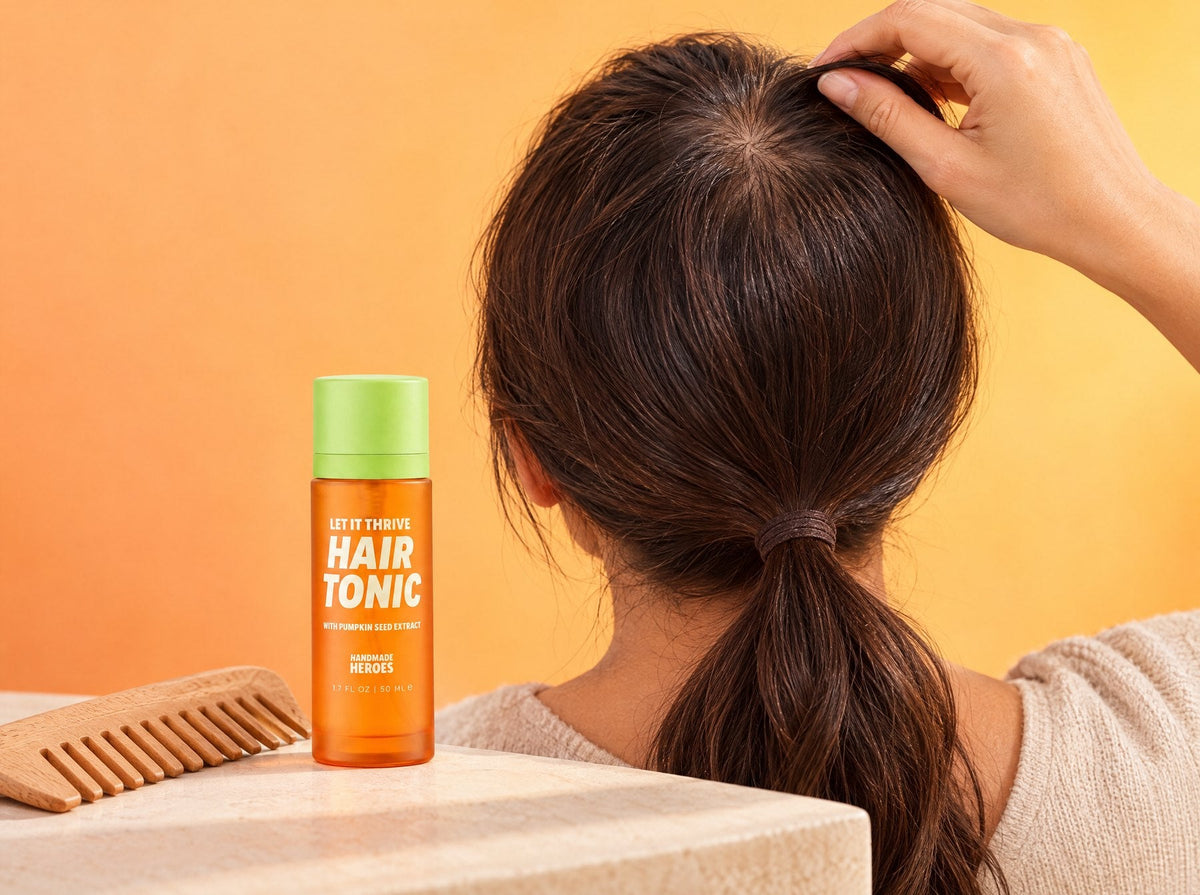
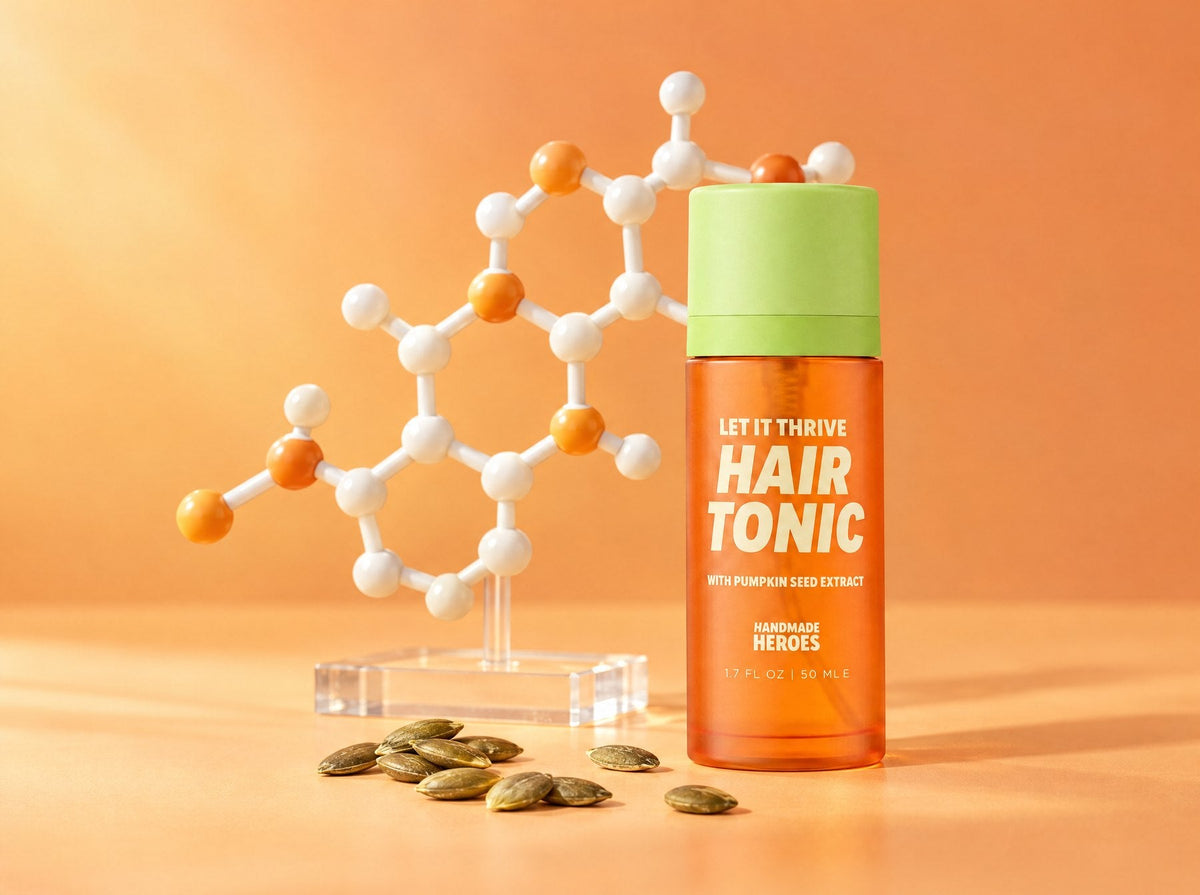
That’s exactly what our Let It Thrive Hair Tonic is made for. It’s a lightweight, leave-in scalp tonic built on pumpkin seed extract and rosemary that supports a healthy-looking scalp and the appearance of fuller, thicker-looking hair, with no prostaglandins and no biotin. One spray, a 30–60 second massage, done. (Curious about the rosemary half? Here’s what the rosemary research actually says.)
Why pumpkin seed, specifically? The 2014 Cho trial and the 2021 Ibrahim trial are why we chose it. Honest caveat, because we don’t do hype: those studies used capsules and concentrated oil preparations in specific groups of people. They’re the reason pumpkin seed is in the bottle, not a promise that a cosmetic tonic will match their results.
If you’re going to build one small ritual around what the research points to, make it the easy one. Give your scalp its daily 10 seconds — shop the Let It Thrive Hair Tonic. Browse the full hair care collection.
When to see a professional
See a doctor or board-certified dermatologist if your hair loss:
- is sudden, patchy or getting worse quickly
- comes with a sore, itchy or scaly scalp
- arrives with other symptoms, like fatigue or irregular periods
- doesn’t settle after a few months
Thyroid problems, low iron and hormonal conditions are common, treatable causes worth ruling out. Proven treatments like minoxidil and finasteride are also worth a conversation with your doctor.
Pumpkin seed oil for hair FAQ
Is pumpkin seed oil better taken as a supplement or applied topically?
The strongest single trial is oral: placebo-controlled, in men (Cho et al., 2014). The topical evidence is newer and smaller: one 3-month trial in women without a placebo group (Ibrahim et al., 2021), plus an uncontrolled 8-week serum study. Talk to your healthcare provider before starting any supplement.
How long before you see results from pumpkin seed oil?
The studies ran for 8 weeks to 6 months. Hair grows in slow cycles, so give any scalp routine at least 3–6 months of consistent use before you judge it.
Does pumpkin seed oil work for women?
It’s been studied in women now, but only a little. The 2021 Ibrahim trial was entirely in women with female pattern hair loss and found improvements over 3 months, and the 2022 serum study included women too. Both were small and neither had a placebo group, so more research is needed.
Is pumpkin seed oil safe on the scalp?
In the capsule trial, side effects were no different from placebo (Cho et al., 2014). The 2022 serum didn’t irritate lab-grown human skin, and a mouse study found no signs of genetic damage or liver toxicity (da Cruz et al., 2022). As with any new product, patch test first, and skip it if you’re allergic to pumpkin or seeds.
More on scalp and hair care
- Stressed-Out Hair: Why Stress Makes You Shed, and How to Look After Your Scalp
- Crash Diets and Thinning Hair: The Link, and How to Look After Your Scalp
- Postpartum Shedding: What's Normal After Baby, and How to Care for Your Scalp
- Why GLP-1 Users (Ozempic, Wegovy, Mounjaro) Are Losing Hair, and What Actually Helps
- Do Hair Oils Actually Work?
- Minoxidil and Cats: Why Pet Owners Skip It (and the Gentle Alternative)
- Minoxidil-Free, Biotin-Free, Prostaglandin-Free: The Let It Thrive Philosophy
- Pumpkin Seed + Rosemary: Why We Paired Them in One Scalp Tonic
- Hair Tonic vs. Hair Oil vs. Hair Serum: What's the Difference?
- Menopause and Thinning Hair: What Changes, and How to Care for Your Scalp
- Pumpkin Seed Oil vs. Saw Palmetto: Comparing the Evidence for Thinning Hair
- Scalp Massage for Thicker-Looking Hair: What the Studies Show
- Pumpkin Seed Oil for Women's Thinning Hair: What the Research Shows
- How to Use a Scalp Tonic (and the Mistakes That Waste It)
- Should You Eat Pumpkin Seeds for Your Hair? Zinc, Nutrition and the Evidence
- Widening Part or Thinning Crown? Early Signs of Thinning Hair in Women
- Can You Use a Pumpkin Seed Scalp Tonic With Minoxidil or Finasteride?
- What Is DHT? The Hormone Behind Pattern Thinning, Explained
- Natural Hair Loss Remedies, Ranked by the Evidence
- Receding Hairline or Mature Hairline? How to Tell (and What to Do First)
- Pumpkin Seed Oil Capsules vs. Topical: Which Does the Research Support?
- Every Ingredient in Let It Thrive Hair Tonic, Explained
- PCOS and Thinning Hair: The Androgen Link, and Gentle Scalp Care
- Does Pumpkin Seed Oil Block DHT? The Science, Explained Simply
- Is Pumpkin Seed Oil Safe for Your Scalp? Side Effects, Allergies and Patch Testing
- How Long Does a Scalp Tonic Take? The Hair Cycle, Honestly
Sources
- Cho Y.H. et al. (2014). Effect of pumpkin seed oil on hair growth in men with androgenetic alopecia: a randomized, double-blind, placebo-controlled trial. Evidence-Based Complementary and Alternative Medicine.
- Verma H. (2015). Comment on “Effect of pumpkin seed oil on hair growth in men with androgenetic alopecia”. Evidence-Based Complementary and Alternative Medicine.
- Ibrahim I.M. et al. (2021). Pumpkin seed oil vs. minoxidil 5% topical foam for the treatment of female pattern hair loss: a randomized comparative trial. Journal of Cosmetic Dermatology.
- Teeranachaideekul V. et al. (2022). Pumpkin seed oil-loaded niosomes for topical application: 5α-reductase inhibitory, anti-inflammatory, and in vivo anti-hair loss effects. Pharmaceuticals.
- Hajhashemi V. et al. (2019). Beneficial effects of pumpkin seed oil as a topical hair growth promoting agent in a mice model. Avicenna Journal of Phytomedicine.
- da Cruz G.K. et al. (2022). Evaluation of the efficacy and toxicity of oral and topical pumpkin oil on the hair growth of mice. Acta Histochemica.
Real ingredients. Real results.



Leave a comment
This site is protected by hCaptcha and the hCaptcha Privacy Policy and Terms of Service apply.