
TL;DR: Yes, some people shed hair on GLP-1 medications like semaglutide (Ozempic/Wegovy) and tirzepatide (Mounjaro/Zepbound). But the research points to telogen effluvium — shedding triggered by rapid weight loss and metabolic stress, not the drug attacking your follicles. It’s usually temporary — and there’s a simple, gentle way to look after your scalp while it recovers.
What the trials actually found
In the STEP trials behind semaglutide’s weight-loss approval, hair loss was reported by about 3% of people on semaglutide versus under 1% on placebo, including at the two-year mark (STEP 5 trial). So it’s real — but it’s the minority. And here’s the telling detail: it tracked with how much weight people lost. Those losing more than 20% of their body weight reported it roughly twice as often as those who lost less (around 5% versus 2.5%). That points hard at the actual cause.
It’s (usually) the weight loss, not the drug
The mechanism dermatologists point to is telogen effluvium: rapid weight loss and the metabolic stress of a big calorie drop can tip a chunk of hair from its growing phase into its resting-then-shedding phase, surfacing as diffuse shedding two to three months later (StatPearls). It’s the same reason crash diets and major life stress cause shedding (we wrote about diet-related shedding here). A 2025 systematic review of GLP-1 medications and hair loss concluded telogen effluvium was the predominant pattern, that tirzepatide — which tends to drive the most weight loss — was most frequently linked, and that women were disproportionately affected while higher doses were more implicated (systematic review; JAAD tirzepatide cohort). In short: the faster and bigger the weight loss, the more likely the shed — consistent with telogen effluvium, not direct follicle toxicity.
The reassuring part
Telogen effluvium is usually self-limiting. Shedding tends to peak around months four to six and settle within six to twelve months — and in the clinical picture, many people’s shedding eases even while they stay on the medication (StatPearls; systematic review). Your hair generally hasn’t been lost for good; it’s been pushed into shedding, and the cycle resets as your weight and nutrition stabilize.
What actually helps
- Don’t stop your medication on your own. If the shedding worries you, talk to your prescriber — there can be other factors (like low iron or protein) worth checking.
- Mind protein and iron. Rapid weight loss usually means eating much less; protein and iron matter for hair, and deficiencies are common and fixable (Guo & Katta, 2017; ferritin & telogen effluvium). A doctor can test.
- Go gentle. Loose styles, soft handling, easy on heat while you’re shedding more than usual.
- Look after the scalp. A healthy-looking scalp is the foundation — and it’s the one part of this that’s entirely in your hands (more on that next).
The 10-second daily habit that puts you back in control
Here’s the good news: while your body resets, you don’t have to just watch the shower drain and hope. A little daily attention to your scalp is the one move that’s completely in your control — and doing something feels a whole lot better than doing nothing.
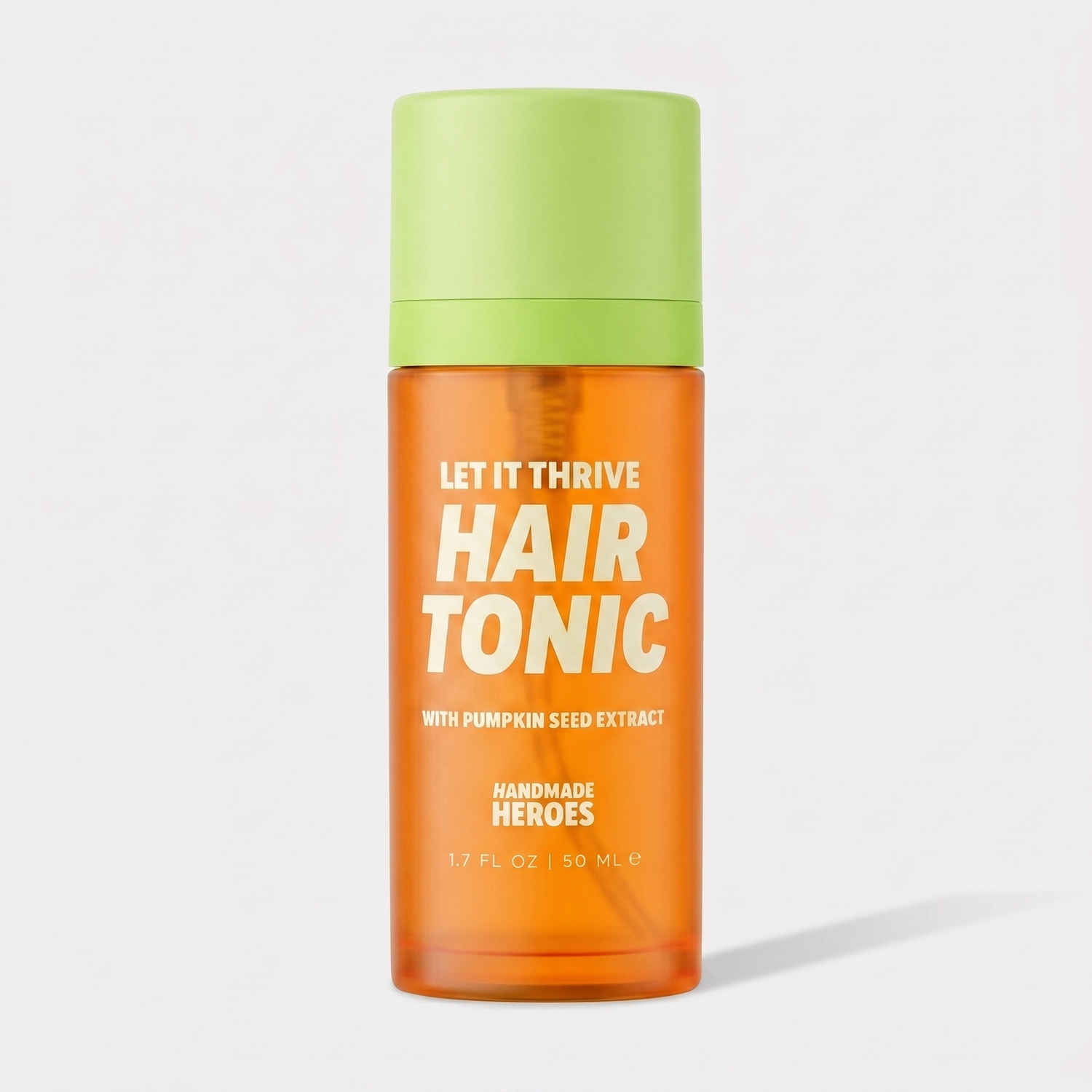
That’s exactly what our Let It Thrive Hair Tonic is made for. It’s a lightweight, leave-in scalp tonic built on rosemary and pumpkin seed extract — two of the most-researched botanicals in scalp care — that supports a healthy-looking scalp and the appearance of fuller, thicker-looking hair, with no prostaglandins and no biotin. One spray, a 30-second massage, done: no rinsing, no grease, nothing extra to juggle on an already-full plate.
Why those two botanicals? Rosemary performed comparably to 2% minoxidil for pattern hair loss in a 2015 randomized trial (Panahi et al.), and oral pumpkin seed oil raised hair count versus placebo in 2014 (Cho et al.). Honest caveat, because we don’t do hype: those studies were on scalp pattern hair loss, so they’re why we chose these ingredients — not a promise to treat medication-related shedding. The Hair Tonic is supportive, cosmetic scalp care for the in-between; it won’t replace eating enough or a conversation with your doctor.
If you’re going to build one small ritual while your hair finds its rhythm again, make it the easy one. Give your scalp its daily 10 seconds — shop the Let It Thrive Hair Tonic.
When to see a professional
If shedding is sudden, severe, patchy, comes with a sore scalp, or doesn’t settle within several months, see a doctor or dermatologist — and always loop in the doctor who prescribed your GLP-1 before changing anything (StatPearls).
GLP-1 hair loss FAQ
Does Ozempic or Wegovy cause hair loss? A minority of users shed — about 3% in the semaglutide trials versus under 1% on placebo — and it’s tied to how much weight you lose, which points to telogen effluvium rather than the drug itself (STEP 5).
Is GLP-1 hair loss permanent? Usually no — telogen effluvium is typically temporary, peaking around months four to six and settling within six to twelve months, often even while you stay on the medication (StatPearls).
Should I stop my medication? Not on your own — talk to your prescriber. The shedding is usually temporary and manageable.
Can a scalp tonic help? A conditioning scalp tonic like the Let It Thrive Hair Tonic supports a healthy-looking scalp and the appearance of fuller-looking hair as part of a gentle daily routine — cosmetic care, not a treatment for hair loss.
General information, not medical advice. Talk to your doctor, and be gentle with your scalp meanwhile.
Sources
- STEP 5 trial (two-year semaglutide; alopecia reporting). ncbi.nlm.nih.gov/PMC9556320
- Hair Loss Associated With GLP-1 Receptor Agonist Use: A Systematic Review. PMC12530271
- JAAD — Increased risk of telogen effluvium with tirzepatide (TriNetX cohort, 2025). jaad.org
- StatPearls — Telogen Effluvium. ncbi.nlm.nih.gov/books/NBK430848
- Guo & Katta 2017 dpcj.org · Ferritin & TE PMC7882421 · Panahi 2015 ref · Cho 2014 PMC4017725
Real ingredients. Real results.



Leave a comment
This site is protected by hCaptcha and the hCaptcha Privacy Policy and Terms of Service apply.