



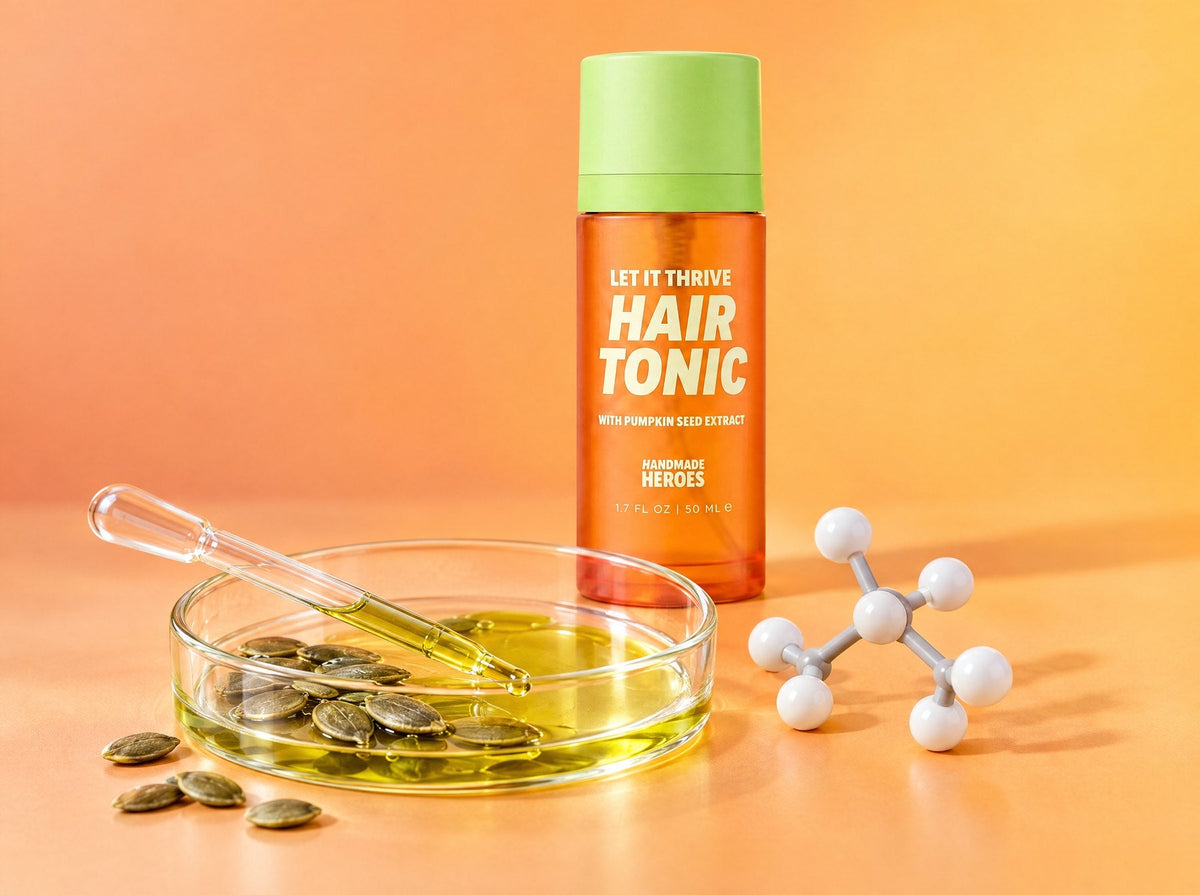
TL;DR: In lab and animal studies, pumpkin seed oil preparations have slowed 5α-reductase, the enzyme that makes DHT, and blunted some of testosterone's effects. In people, nobody has shown that pumpkin seed oil lowers DHT: the main hair trial measured hair, not DHT, and free testosterone didn't change. "DHT blocker" is a hypothesis with some lab support, not something shown in humans.
"DHT blocker" shows up on a lot of labels: supplements, shampoos, serums. Pumpkin seed oil is one of the ingredients it gets attached to most often — and it's a fair thing to wonder about, because DHT really is central to pattern hair loss in men.
But "this ingredient blocks DHT" is a claim with several steps in it, and each step needs its own evidence. So let's climb the ladder one rung at a time, from lab to animal to human, and label each rung clearly.
This article is general information, not medical advice. For sudden, patchy or persistent hair loss, see a board-certified dermatologist.
What is DHT, and why does it matter for hair?
Dihydrotestosterone (DHT) is made from testosterone by an enzyme called 5α-reductase. Studies of men born with a 5α-reductase deficiency, who make little DHT, and of men with very low testosterone, pointed to DHT as a key driver of male pattern hair loss. Finasteride, a drug that blocks one form of 5α-reductase, then improved hair in men in controlled trials, alongside measured drops in scalp DHT (Kaufman, 2002).
Pattern hair loss itself is very common: a genetically driven, exaggerated response of scalp follicles to androgens that affects roughly half of men and women (Ho et al., 2024). In women, though, DHT is a less tidy story. Finasteride didn't improve hair in postmenopausal women with female pattern hair loss, which suggests the male and female forms work differently (Kaufman, 2002). For the full explainer, see What Is DHT?
What's actually in pumpkin seed oil?
A 2026 analysis of cold-pressed pumpkin seed oil gives a useful snapshot (Czwartkowski et al., 2026):
- Fatty acids: mostly linoleic acid (50.49%) and oleic acid (31.30%), with smaller amounts of palmitic and stearic acid. Linolenic acid was a trace, at 0.21%.
- Plant sterols: about 450 mg per 100 g of oil, which the authors describe as a high level.
- Which sterols: Δ7-stigmasterol (50.4% of the sterols) and Δ7-avenasterol (18.2%) dominated. β-sitosterol, the plant sterol most often linked to 5α-reductase, made up just 5.8%.
- Vitamin E family and squalene: mostly gamma-tocopherol, plus squalene.
Why does this matter? Reviews often credit pumpkin seed oil's possible anti-DHT effect to β-sitosterol or linolenic acid (Gupta et al., 2025; Teeranachaideekul et al., 2022). In this sample, both were minor components. The Δ7-sterols that made up most of the sterol fraction are pumpkin seed oil's more distinctive feature, and we couldn't find a study testing them directly against 5α-reductase. One sample isn't every oil, and published values vary from sample to sample, but it's a good reminder that "contains plant sterols" and "blocks DHT" are very different statements.
The evidence, rung by rung
In the lab: yes, in cells
The clearest lab result comes from a 2022 formulation study. Pumpkin seed oil packaged in niosomes (tiny carrier vesicles) inhibited 5α-reductase activity in DU-145 cells, a human prostate cancer cell line, and dampened IL-6, an inflammatory signal, in immune cells (Teeranachaideekul et al., 2022). That's a real finding with a real limit: a cell culture can't tell you whether enough of the oil reaches the right place in a living scalp to matter.
In animals: signs of anti-androgen activity
In mice whose hair growth had been suppressed with testosterone, 10% pumpkin seed oil applied to the skin for three weeks raised the share of follicles in the growing phase to 75%, versus 44.4% with testosterone alone; 2% minoxidil reached 91.3% (Hajhashemi et al., 2019). In rats, oral pumpkin seed oil limited testosterone-driven enlargement of the prostate, with a significant effect at the higher dose (Gossell-Williams et al., 2006). Both results fit the idea of an anti-androgen effect. Neither measured DHT in the scalp, and rodents aren't people.
In people: hair counts, not hormones
The landmark human trial gave 76 men with pattern hair loss 400 mg of pumpkin seed oil a day, or placebo, for 24 weeks. Hair counts rose 40% versus 10%, but the authors note that DHT wasn't measured, so they couldn't explain how the oil worked. Free testosterone didn't change in either group (Cho et al., 2014; Gupta et al., 2025). Our pumpkin seed oil explainer covers that trial's other caveats.
Pumpkin seed has also been tested where DHT matters a great deal: the prostate. In the year-long GRANU trial, 1,431 men aged 50 to 80 with urinary symptoms from an enlarged prostate took pumpkin seed extract capsules, whole pumpkin seeds (5 g twice a day) or a placebo. The capsules didn't beat placebo on the main measure. The seeds produced more responders (58.5% vs. 47.3%), a difference the authors called "descriptively significant" and said needs confirming (Vahlensieck et al., 2015). That trial tracked symptoms, not DHT, and the prostate isn't the scalp. Pumpkin seed also appears, alongside saw palmetto and nettle root, in a review of herbal prostate remedies, some of which are thought to work by modulating 5α-reductase (Csikós et al., 2021). For how it stacks up against its best-known rival, see Pumpkin Seed Oil vs. Saw Palmetto.
So, does pumpkin seed oil block DHT?
Here's the honest scorecard:
- Lab evidence: yes, a pumpkin seed oil formulation inhibited the enzyme in prostate cells.
- Animal evidence: consistent with an anti-androgen effect in mice and rats, though DHT in the scalp wasn't measured.
- Human evidence: no study has shown pumpkin seed oil lowering DHT in people. The main hair trial didn't measure it, and testosterone didn't move.
Compare that with finasteride, where trials measured lower scalp DHT alongside hair improvements in men (Kaufman, 2002). That's what "proven" looks like for a DHT blocker. Finasteride is a prescription medicine with its own benefits and side effects to talk through with a doctor; pumpkin seed oil is an interesting botanical with a plausible mechanism and a short evidence trail. A fair summary is "may influence DHT pathways in lab and animal studies." "DHT blocker" overreaches.
Why you won't see "DHT blocker" on our tonic
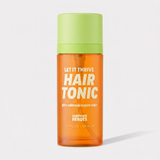
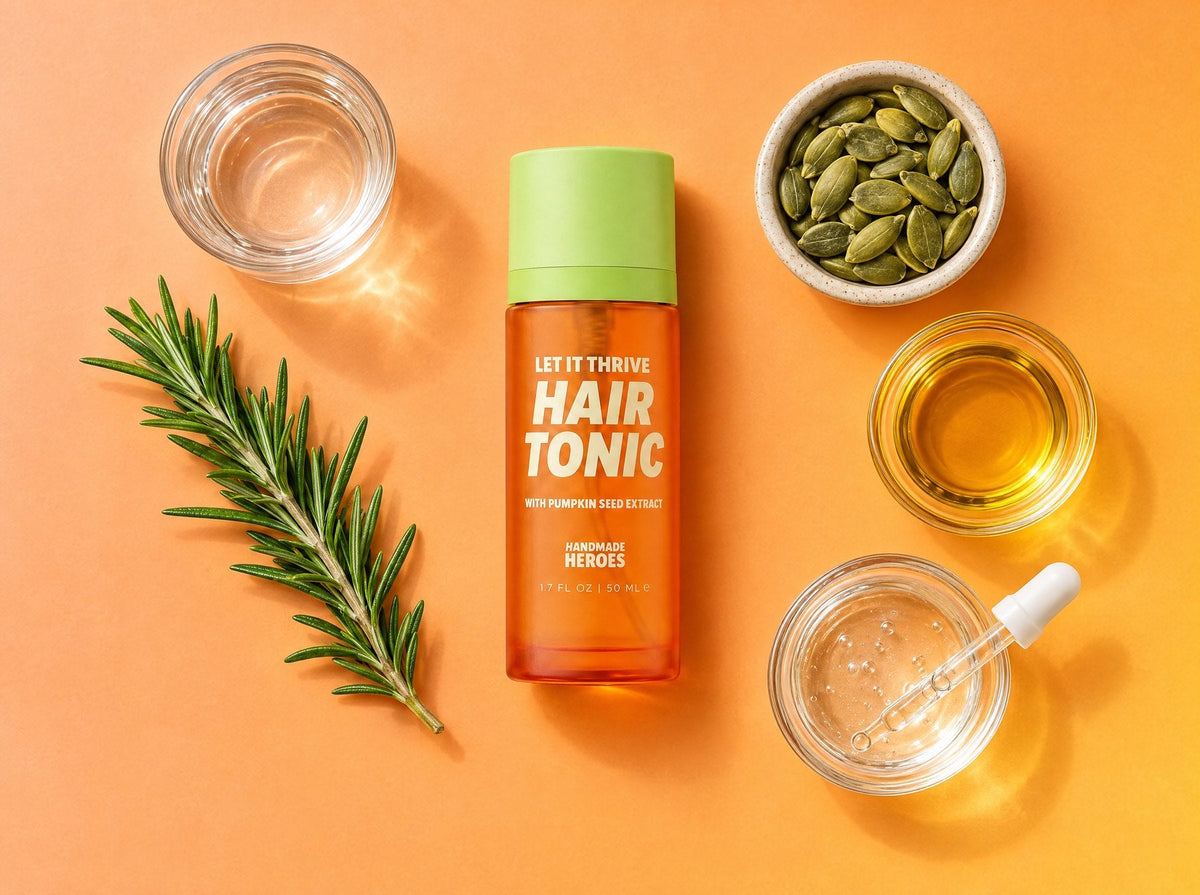
After all of that, putting "DHT blocker" on a cosmetic would be overselling it, so you won't find those words on our Let It Thrive Hair Tonic. What we do say is narrower, and true. It's a lightweight leave-in scalp tonic with pumpkin seed extract (listed on the label as Cucurbita pepo (pumpkin) seed oil) and rosemary leaf extract that helps the scalp feel balanced, refreshed and healthy-looking and, with regular use, supports the appearance of fuller, thicker-looking hair. It absorbs fast with no greasy residue, it's 100% naturally derived and vegan, and there's no minoxidil, no prostaglandins and no biotin in it.
Honest caveat, because we don't do hype: the lab, animal and human research above is why pumpkin seed earned its place in the formula. It isn't evidence that the tonic changes your hormones, and the tonic doesn't claim to. In our FAQ's words, it's a cosmetic conditioning tonic, not a hair-loss treatment.
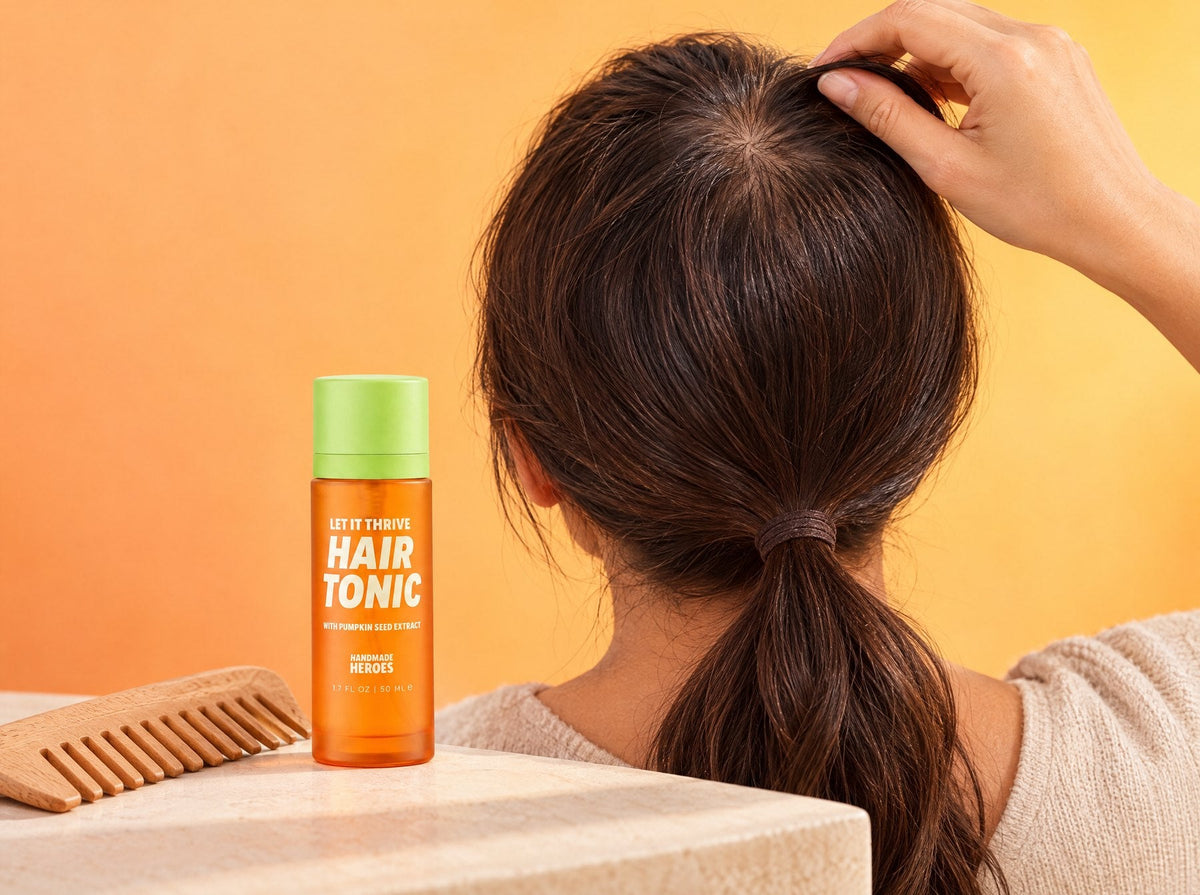
The routine fits into a minute: part your hair, spray the scalp, massage with your fingertips for 30–60 seconds, and leave it in. Once a day, morning or night.
Choose scalp care that says exactly what it does — shop the Let It Thrive Hair Tonic.
When to see a professional
Talk to a board-certified dermatologist if:
- hair loss is sudden, patchy or moving fast; patchy loss can be alopecia areata
- your scalp is sore, burning or looks scarred
- other symptoms show up, such as fatigue, irregular periods, acne or new facial hair, which can point to thyroid problems, iron deficiency or PCOS
- shedding started after a new medication (don't stop it yourself; ask your prescriber)
- you're weighing a prescription DHT-lowering drug, or a supplement sold as a "DHT blocker"; both deserve a conversation about benefits, risks and interactions
Pumpkin Seed Oil and DHT FAQ
Is pumpkin seed oil a DHT blocker?
Not in any way that's been shown in people. A pumpkin seed oil formulation inhibited 5α-reductase in lab cells (Teeranachaideekul et al., 2022), but the main human trial didn't measure DHT (Cho et al., 2014). "May influence DHT pathways" is fair; "blocks DHT" isn't.
Does pumpkin seed oil lower testosterone?
In the 24-week trial of 400 mg daily capsules in men, free testosterone didn't change, and neither did liver tests (Cho et al., 2014). That's one trial in men, so if you have a hormone-related condition, ask your doctor before taking it as a supplement.
Is pumpkin seed oil as strong as finasteride?
They've never been compared head to head. Finasteride's effect on scalp DHT was measured in trials (Kaufman, 2002); pumpkin seed oil's hasn't been. Finasteride is a prescription drug, so that comparison belongs in a conversation with your doctor.
Does DHT cause female pattern hair loss too?
It's less clear-cut in women. Finasteride didn't improve hair in postmenopausal women with female pattern hair loss, which points to different mechanisms (Kaufman, 2002). An expert task force still recommends checking every woman with pattern thinning for androgen excess, such as PCOS (Carmina et al., 2019). More in Pumpkin Seed Oil for Women's Thinning Hair.
Sources
- Kaufman KD (2002). Androgens and alopecia. Molecular and Cellular Endocrinology. PubMed 12573818
- Ho CH, Sood T, Zito PM (2024). Androgenetic alopecia. StatPearls. NCBI Bookshelf NBK430924
- Czwartkowski K, Nizio E, Marcinkowski D, Kmiecik D, Grygier A, Siger A, et al. (2026). Analysis of Quality Distinctions of Pumpkin Seed Oil (Cucurbita pepo var. oleifera) and Walnut Oil (Juglans regia L.). Molecules. PMC13118477
- Gupta AK, Wang H, Wang T, Talukder M (2025). Do Non-Prescription Products Help in Managing Androgenic Alopecia? Skin Appendage Disorders. PMC12136554
- Teeranachaideekul V, Parichatikanond W, Junyaprasert VB, Morakul B (2022). Pumpkin Seed Oil-Loaded Niosomes for Topical Application: 5α-Reductase Inhibitory, Anti-Inflammatory, and In Vivo Anti-Hair Loss Effects. Pharmaceuticals. PMC9412580
- Hajhashemi V, Rajabi P, Mardani M (2019). Beneficial effects of pumpkin seed oil as a topical hair growth promoting agent in a mice model. Avicenna Journal of Phytomedicine. PMC6823528
- Gossell-Williams M, Davis A, O'Connor N (2006). Inhibition of testosterone-induced hyperplasia of the prostate of sprague-dawley rats by pumpkin seed oil. Journal of Medicinal Food. PubMed 16822218
- Cho YH, Lee SY, Jeong DW, Choi EJ, Kim YJ, Lee JG, et al. (2014). Effect of pumpkin seed oil on hair growth in men with androgenetic alopecia: a randomized, double-blind, placebo-controlled trial. Evidence-Based Complementary and Alternative Medicine. PMC4017725
- Vahlensieck W, Theurer C, Pfitzer E, Patz B, Banik N, Engelmann U (2015). Effects of pumpkin seed in men with lower urinary tract symptoms due to benign prostatic hyperplasia in the one-year, randomized, placebo-controlled GRANU study. Urologia Internationalis. PubMed 25196580
- Csikós E, Horváth A, Ács K, Papp N, Balázs VL, Dolenc MS, et al. (2021). Treatment of Benign Prostatic Hyperplasia by Natural Drugs. Molecules. PMC8659259
- Carmina E, Azziz R, Bergfeld W, Escobar-Morreale HF, Futterweit W, Huddleston H, et al. (2019). Female Pattern Hair Loss and Androgen Excess: A Report From the Multidisciplinary Androgen Excess and PCOS Committee. Journal of Clinical Endocrinology & Metabolism. PubMed 30785992
Real ingredients. Real results.



Leave a comment
This site is protected by hCaptcha and the hCaptcha Privacy Policy and Terms of Service apply.