
TL;DR: A stressful stretch — illness, surgery, a major life event, months of poor sleep — can tip more of your hair into its shedding phase about two to three months later. Dermatologists call it telogen effluvium, and it’s usually temporary. Be gentle with your scalp, cover the basics, and see a doctor if it doesn’t settle. A simple daily scalp ritual can be the one thing you control while the rest resets. (General information, not medical advice.)
Wait — stress can really do that?
Yes, and the delay is what throws people. A physical or emotional shock can push a chunk of hair out of its growing (anagen) phase and into its resting-then-shedding (telogen) phase — but the extra shedding usually shows up about two to three months after the trigger, long after the stressful bit, which is why it feels like it came from nowhere. Dermatologists call this telogen effluvium, and the reassuring part is that it’s typically self-limiting: most people shed 50–100 hairs a day normally, an episode temporarily raises that, and the cycle resets as life does (StatPearls: Telogen Effluvium).
What actually helps
There’s no overnight switch, but a few honest things make the recovery kinder:
- Mind the basics — sleep, enough food, and managing the stressor itself. Telogen effluvium often traces back to an identifiable trigger (StatPearls).
- Be gentle. Skip tight ponytails, harsh brushing on wet hair, and aggressive heat while you’re shedding more than usual.
- Look after the scalp. Healthy-looking hair starts at a healthy-looking scalp, so a little daily scalp care goes a long way.
The 10-second daily habit that puts you back in control
Here's the good news: while your body resets from the stress that triggered all this, you don't have to just watch the shower drain and hope. A little daily attention to your scalp is the one move that's completely in your control — and doing something feels a whole lot better than doing nothing.
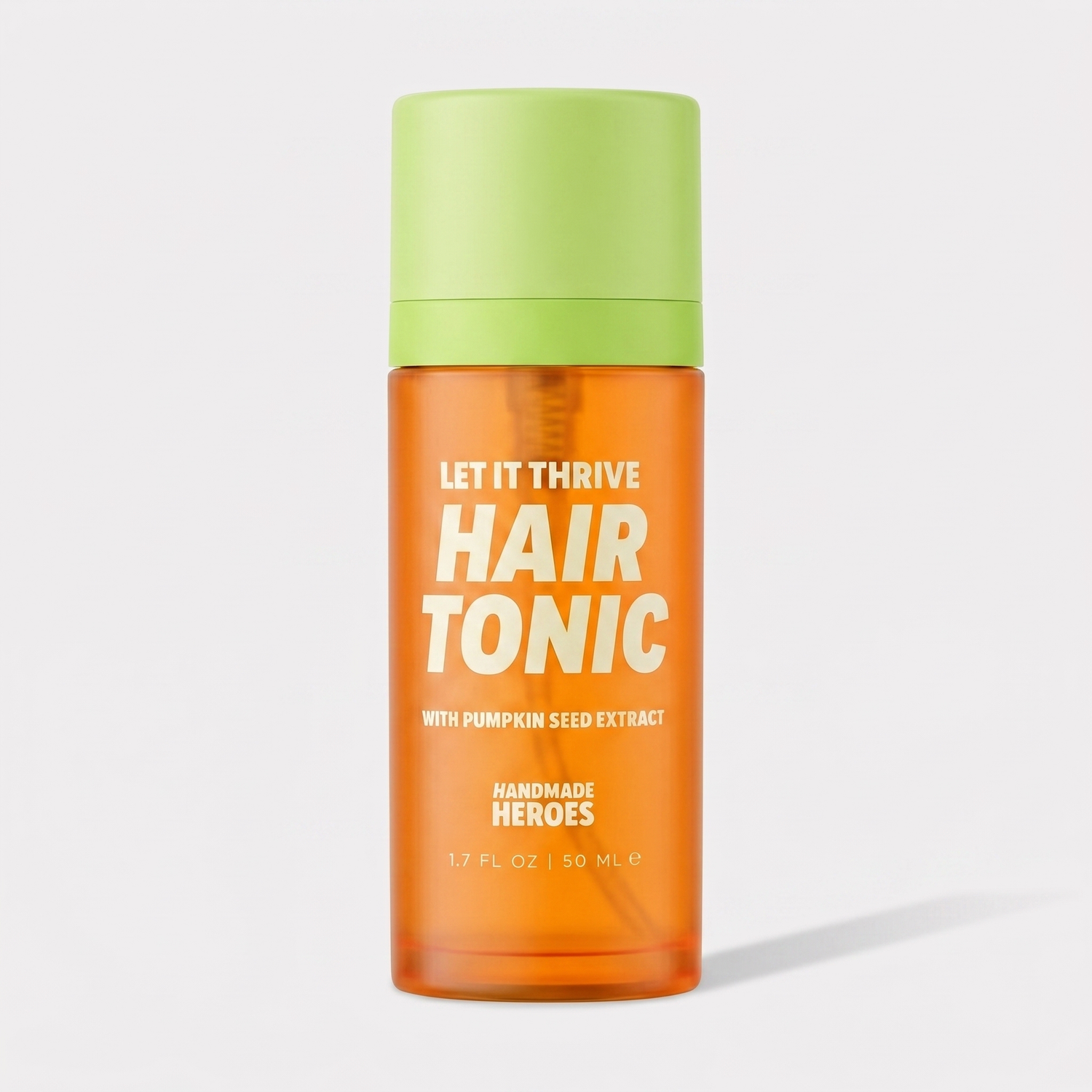
That's exactly what our Let It Thrive Hair Tonic is made for. It's a lightweight, leave-in scalp tonic built on rosemary and pumpkin seed extract — two of the most-studied botanicals in scalp care — that supports a healthy-looking scalp and the appearance of fuller, thicker-looking hair, with no prostaglandins and no biotin. One spray, a 30-second massage, done.
Why those two botanicals? Rosemary performed comparably to 2% minoxidil for pattern hair loss over six months in a 2015 randomized trial (Panahi et al., 2015), and oral pumpkin seed oil raised hair count versus placebo in a 2014 trial (Cho et al., 2014). Honest caveat, because we don't do hype: those studies looked at pattern hair loss (and one was an oral supplement) — so they're why we chose these ingredients, not a promise to treat stress-related shedding.
If you're going to build one small ritual while your hair finds its rhythm again, make it the easy one. Give your scalp its daily 10 seconds — shop the Let It Thrive Hair Tonic. See the full hair range.
When to see a professional
If your shedding is sudden, patchy, comes with a sore or flaky scalp, or hasn’t settled after a few months, see a doctor or dermatologist — other causes (like low iron or thyroid changes) are worth ruling out (StatPearls).
Stress-shedding FAQ
How long does stress shedding last? Telogen effluvium usually eases within three to six months once the trigger passes, as the hair cycle rebalances (StatPearls).
Will it grow back? Because the hair generally hasn’t been lost permanently — just shifted into shedding — most people see fullness return as the cycle resets; manage the trigger and the basics.
Can a scalp tonic help? A conditioning scalp tonic supports a healthy-looking scalp and the appearance of fuller hair as part of a gentle routine; it’s cosmetic care, not a medical treatment for hair loss.
Sources
- StatPearls (NCBI Bookshelf) — Telogen Effluvium. ncbi.nlm.nih.gov/books/NBK430848
- Panahi et al., Skinmed 2015. reference
- Cho et al., 2014. PMC4017725
Real ingredients. Real results.



Leave a comment
This site is protected by hCaptcha and the hCaptcha Privacy Policy and Terms of Service apply.