





TL;DR: The trial behind the "pumpkin seed oil vs. minoxidil" headlines gave 60 women with female pattern hair loss either topical pumpkin seed oil or 5% minoxidil foam for three months. Both groups improved on scalp-microscope measures, but there was no placebo group and no reported comparison between the two, so it can't show pumpkin seed oil works as well as minoxidil. Minoxidil is still the proven, FDA-approved option; pumpkin seed oil is a promising botanical that needs bigger trials.
If you've read anything about thinning hair online lately, you've probably met the headline: pumpkin seed oil works as well as minoxidil. It's an appealing idea. One is a seed oil you can buy at the grocery store. The other is a drug you apply every day, indefinitely, to keep its benefits.
So we went back to the study behind the headline and read what it actually measured. It's a genuinely interesting trial — and a much smaller, looser one than the headline suggests. Here's what it found, what it can't tell you, and how to think about the two side by side.
This article is general information, not medical advice. For sudden, patchy or persistent hair loss, see a board-certified dermatologist.
What did the pumpkin seed oil vs. minoxidil trial actually test?
The study is a randomized comparative trial published in the Journal of Cosmetic Dermatology (Ibrahim et al., 2021). Sixty women with female pattern hair loss were randomly split into two groups of 30:
- Pumpkin seed oil: applied to the scalp. A 2024 review that summarized the trial gives the amount as 1 mL (Bin Rubaian et al., 2024); the trial's own published summary doesn't describe the preparation.
- Minoxidil: 5% minoxidil foam, a strength sold over the counter for women.
Both groups used their product for three months. Each woman's scalp was assessed at the start, at six weeks and at three months, by eye and with dermoscopy, a magnified camera view that lets a clinician count and compare individual hairs. Three measures matter for reading the results:
- Hair shaft diversity: how much hair thickness varies across the scalp. Pattern thinning shrinks some follicles and leaves a mix of thick and fine hairs, so a lower number is better.
- Vellus hairs: very short, fine, wispy hairs. More of them can mean more follicles are shrinking.
- Upright regrowing hairs: short new hairs standing straight up from the scalp, the dermoscopy sign of fresh hair coming through.
What did it find?
Here are the numbers from the trial's published summary (Ibrahim et al., 2021). In the pumpkin seed oil group:
- hair shaft diversity fell from 30.5% to 24.0%
- vellus hairs fell from an average of 22.5 to 15.8
- upright regrowing hairs rose from an average of 0.13 to 0.9
In the minoxidil group:
- hair shaft diversity fell from 31.5% to 21.3%
- vellus hairs fell from an average of 24.7 to 19.5
Every one of those changes was statistically significant compared with that group's own starting point, and the authors concluded that pumpkin seed oil has "a promising potential role" in female pattern hair loss. One detail worth noticing: on hair shaft diversity, the minoxidil group moved further. The summary doesn't report whether that gap between the groups is meaningful, so we wouldn't lean on it either way. (For the other studies that include women, see Pumpkin Seed Oil for Women's Thinning Hair.)
Does that mean pumpkin seed oil works as well as minoxidil?
Not on this evidence, and it's worth being precise about why.
- There was no placebo group. Each group was compared only with itself. Hair measurements drift over a few months for reasons that have nothing to do with what you put on your scalp. Shedding even follows a seasonal rhythm, with the most resting hairs in summer and the fewest in late winter (Kunz et al., 2009), so "better than baseline" can't isolate the oil's effect.
- "Both improved" isn't "equally good." Showing that two treatments perform the same takes a trial designed and sized for that question. This one wasn't, and its summary reports no statistics comparing the groups.
- It was small and short. Thirty women per group, for three months.
- Key details are missing. The published summary doesn't describe blinding or exactly how the oil was prepared.
The best-known pumpkin seed study doesn't settle the question either, because it answered a different one. In a randomized, double-blind, placebo-controlled trial, 76 men with mild to moderate pattern hair loss took 400 mg of pumpkin seed oil a day in capsules, or a placebo, for 24 weeks. Average hair counts rose 40% with pumpkin seed oil versus 10% with placebo, while hair thickness didn't change (Cho et al., 2014). That's a stronger design, but it was oral, in men only, and used a branded capsule whose maker supplied the capsules and held the randomization codes. A published comment also pointed out that results for the front of the scalp weren't reported, and argued for trials lasting at least a year (Verma, 2015). Our pumpkin seed oil explainer walks through the rest of the research.
The same caution applies to the other famous botanical-versus-minoxidil trial, which compared rosemary oil with 2% minoxidil for six months. Neither group's hair count changed at three months; both rose by six, with no difference between the groups and, again, no placebo (Panahi et al., 2015). A 2025 review of non-prescription options landed somewhere sensible on pumpkin seed oil: it may not be as effective as topical minoxidil, but it could be an option for people who can't or won't use drug treatments (Gupta et al., 2025).
What minoxidil brings that pumpkin seed oil doesn't (yet)
Minoxidil began life in the 1970s as a blood-pressure medicine. A topical version for pattern hair loss arrived in 1987, first for men and later for women (Patel et al., 2023). Decades on, it's an FDA-approved, over-the-counter treatment with clear instructions:
- Use and timing: the women's 5% foam is used once a day. Its Drug Facts label says results may occur at three months, some women need at least six months, and continued use is necessary, or hair loss will begin again (Drug Facts label).
- Patience: the American Academy of Dermatology suggests using it continuously for about six to 12 months before judging how well it works, and notes that shedding can increase temporarily in the first two to eight weeks (American Academy of Dermatology).
- Expert backing: a task force of dermatology and endocrinology specialists convened by the Androgen Excess and PCOS Society recommends starting treatment for female pattern hair loss with 5% minoxidil (Carmina et al., 2019).
- Who should skip it: the AAD advises women who are pregnant, planning a pregnancy or breastfeeding to avoid minoxidil.
It isn't side-effect-free — in the rosemary trial, scalp itching was more frequent with minoxidil (Panahi et al., 2015) — but if you want the option with the deepest evidence behind it, that's minoxidil, and a dermatologist can help you weigh it.
Where a pumpkin seed scalp tonic fits
Here's how we see it: minoxidil is a medicine, and a scalp tonic is skincare for your scalp. They do different jobs, and you don't have to pick a side.
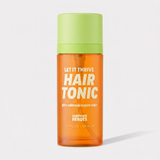
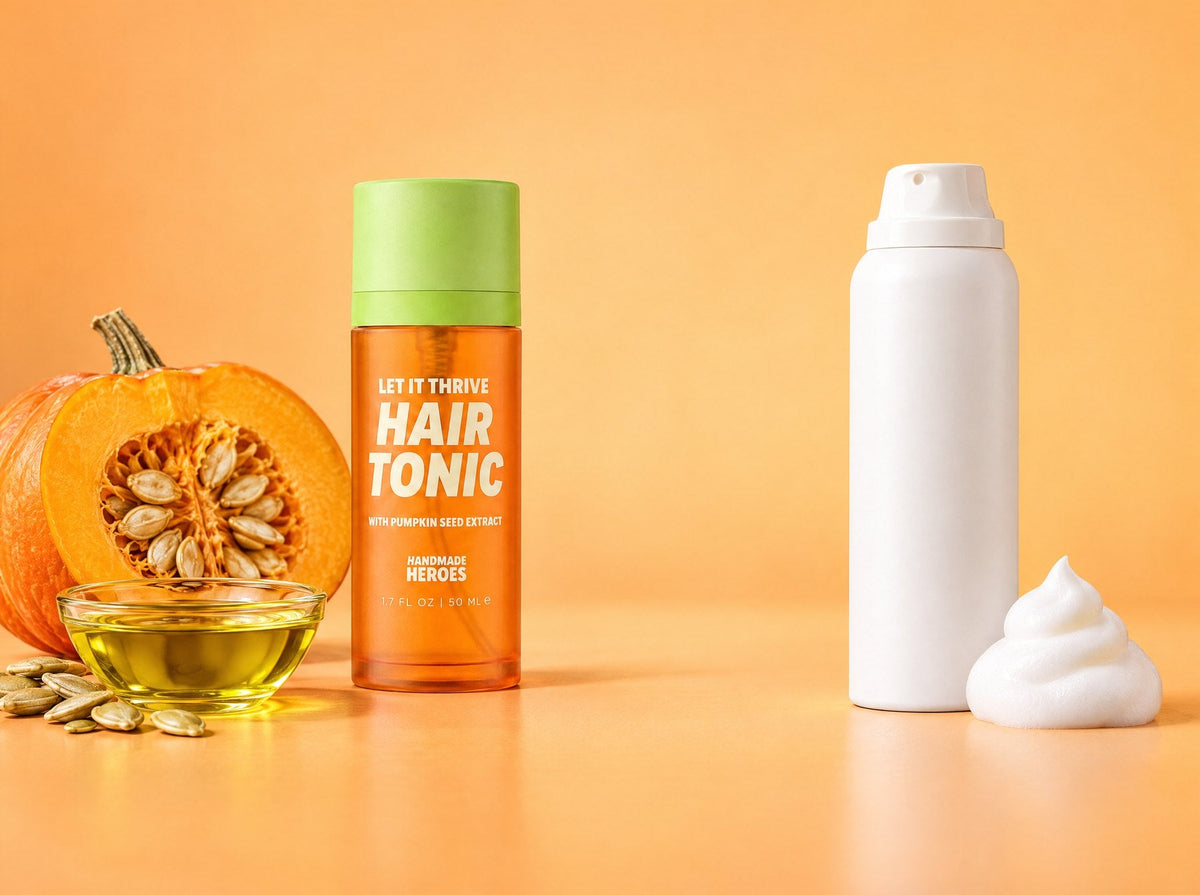
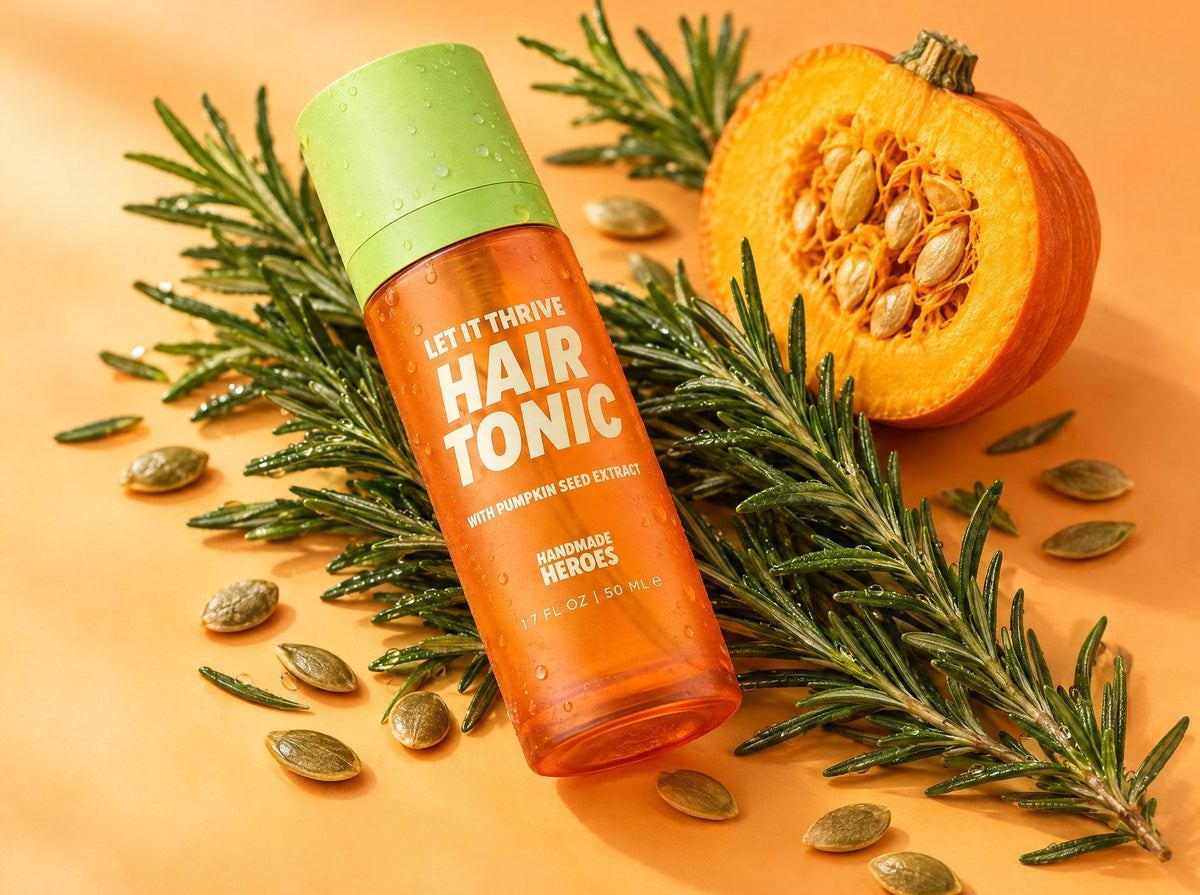
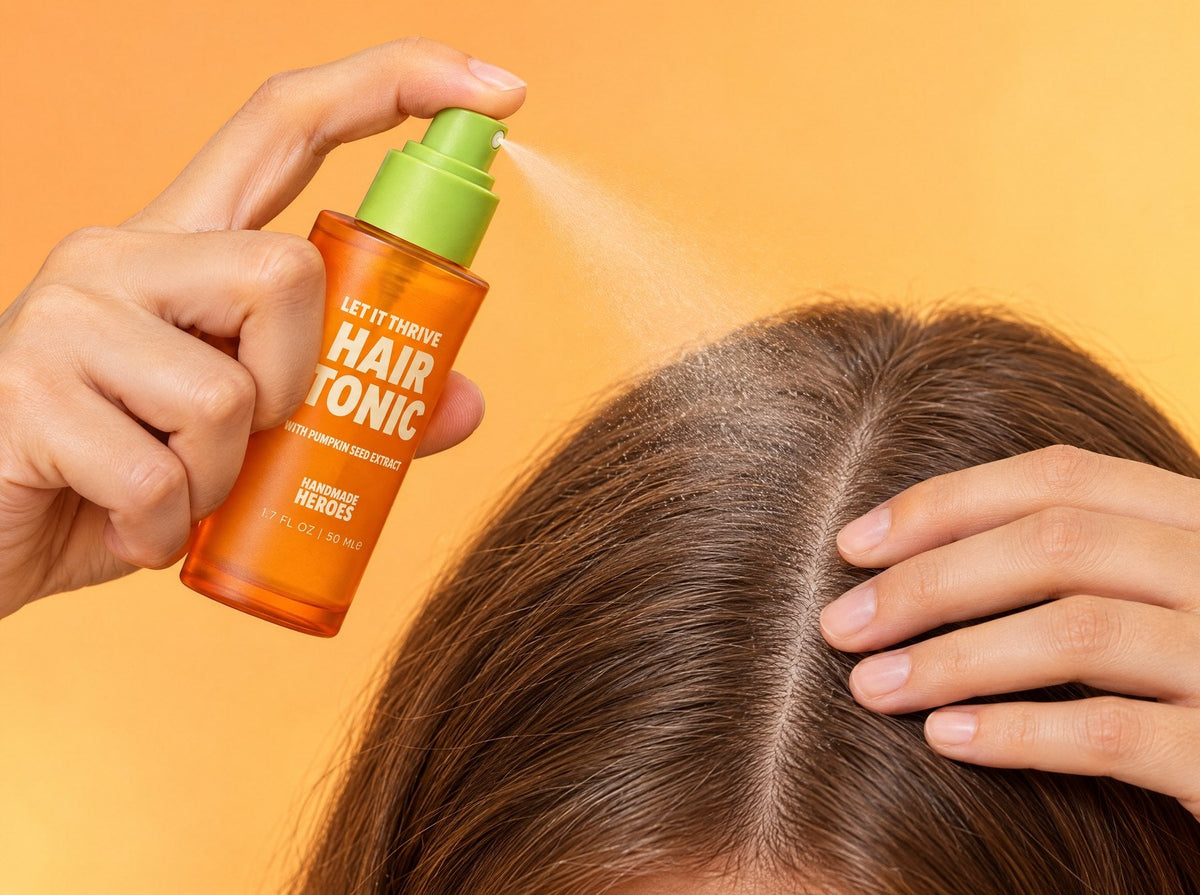
Our Let It Thrive Hair Tonic is a lightweight leave-in spray made with pumpkin seed extract (listed on the label as Cucurbita pepo (pumpkin) seed oil) and rosemary leaf extract. It helps the scalp feel balanced, refreshed and healthy-looking, and with regular use it supports the appearance of fuller, thicker-looking hair. It absorbs fast with no greasy residue, it's 100% naturally derived and vegan, and it contains no minoxidil, no prostaglandins and no biotin (here's why we left those out). The routine takes about a minute: part your hair, spray onto the scalp, massage with your fingertips for 30–60 seconds, and leave it in.
Honest caveat, because we don't do hype: the Ibrahim and Cho trials are the reason pumpkin seed is in our formula, not a forecast of what a cosmetic tonic will do. Those studies used pumpkin seed oil applied to the scalp and 400 mg capsules; our tonic isn't built to deliver either, and it isn't a stand-in for minoxidil. As our own FAQ puts it, it's a cosmetic conditioning tonic, not a hair-loss treatment.
Add an easy scalp step to your day — shop the Let It Thrive Hair Tonic.
When to see a professional
Book a visit with a board-certified dermatologist if:
- hair comes out suddenly or in round patches, which can point to alopecia areata
- your scalp hurts, burns or looks shiny and scarred
- thinning arrives with fatigue, irregular periods, new acne or facial hair, which can point to thyroid issues, iron deficiency or PCOS
- shedding started after you began or stopped a medication (don't stop or switch a prescribed medicine on your own; ask the prescriber)
- you've given a routine a few months and the thinning keeps progressing
A dermatologist can confirm what kind of hair loss you have, order blood tests if they're needed, and talk you through minoxidil and other treatments.
Pumpkin Seed Oil vs. Minoxidil FAQ
Is pumpkin seed oil as effective as minoxidil?
That hasn't been shown. In the head-to-head trial, both groups of women improved over three months, but there was no placebo group and no reported comparison between them (Ibrahim et al., 2021). Minoxidil has decades of evidence and FDA approval; pumpkin seed oil has a handful of small studies.
What if you already use minoxidil?
The combination has not been studied, so ask your dermatologist about timing and irritation before adding a cosmetic scalp tonic to minoxidil. Our guide to using a tonic with minoxidil covers the practical questions; keep following your medication instructions.
How long did the pumpkin seed oil vs. minoxidil trial last?
Three months, with a check-in at six weeks (Ibrahim et al., 2021). That's short for hair: the women's 5% minoxidil foam label says results may show at three months but some women need at least six, and the AAD suggests six to 12 months before judging (American Academy of Dermatology).
Does pumpkin seed oil have side effects?
In the 24-week capsule trial in men, side effects were no different from placebo, and liver tests and free testosterone didn't change (Cho et al., 2014). The topical trial's published summary doesn't detail side effects, so patch test any new scalp product, and skip pumpkin seed products if you're allergic to pumpkin seeds.
Sources
- Ibrahim IM, Hasan MS, Elsabaa KI, Elsaie ML (2021). Pumpkin seed oil vs. minoxidil 5% topical foam for the treatment of female pattern hair loss: A randomized comparative trial. Journal of Cosmetic Dermatology. PubMed 33544448
- Cho YH, Lee SY, Jeong DW, Choi EJ, Kim YJ, Lee JG, et al. (2014). Effect of pumpkin seed oil on hair growth in men with androgenetic alopecia: a randomized, double-blind, placebo-controlled trial. Evidence-Based Complementary and Alternative Medicine. PMC4017725
- Verma H (2015). Comment on "effect of pumpkin seed oil on hair growth in men with androgenetic alopecia: a randomized, double-blind, placebo-controlled trial". Evidence-Based Complementary and Alternative Medicine. PMC4396906
- Panahi Y, Taghizadeh M, Marzony ET, Sahebkar A (2015). Rosemary oil vs minoxidil 2% for the treatment of androgenetic alopecia: a randomized comparative trial. Skinmed. PubMed 25842469
- Gupta AK, Wang H, Wang T, Talukder M (2025). Do Non-Prescription Products Help in Managing Androgenic Alopecia? Skin Appendage Disorders. PMC12136554
- Bin Rubaian NF, Alzamami HFA, Amir BA (2024). An Overview of Commonly Used Natural Alternatives for the Treatment of Androgenetic Alopecia, with Special Emphasis on Rosemary Oil. Clinical, Cosmetic and Investigational Dermatology. PMC11549889
- Kunz M, Seifert B, Trüeb RM (2009). Seasonality of hair shedding in healthy women complaining of hair loss. Dermatology. PubMed 19407435
- Patel P, Nessel TA, Kumar D D (2023). Minoxidil. StatPearls. NCBI Bookshelf NBK482378
- U.S. National Library of Medicine (2024). Women's 5% minoxidil topical aerosol foam: Drug Facts label. DailyMed. DailyMed
- American Academy of Dermatology (2022). Thinning hair and hair loss: could it be female pattern hair loss? AAD.org. aad.org
- Carmina E, Azziz R, Bergfeld W, Escobar-Morreale HF, Futterweit W, Huddleston H, et al. (2019). Female Pattern Hair Loss and Androgen Excess: A Report From the Multidisciplinary Androgen Excess and PCOS Committee. Journal of Clinical Endocrinology & Metabolism. PubMed 30785992
Real ingredients. Real results.



Leave a comment
This site is protected by hCaptcha and the hCaptcha Privacy Policy and Terms of Service apply.