




















TL;DR: The early signs of female pattern hair loss are usually a part that looks wider, more scalp showing on top or at the crown, and a ponytail that feels thinner, while the front hairline mostly stays put. That's different from shedding, where more hairs fall out all over. See a board-certified dermatologist early, and promptly if you notice bald patches, a sore or scarred scalp, or thinning eyebrows with a receding hairline. Treatment works best when it starts at the first sign of hair loss.
Thinning hair rarely announces itself. It shows up in small moments: a part that looks wider in the bathroom mirror, a hair tie that suddenly needs an extra loop, more scalp than you remember under fitting-room lights. The American Academy of Dermatology opens its guide to female pattern hair loss with two of those questions, asking whether your part is widening and your ponytail is thinner, and calls the condition the most common cause of hair loss in women (American Academy of Dermatology). Pattern hair loss affects roughly half of men and women at some point (Ho et al., 2024).
Here's what the early signs look like, how they differ from ordinary shedding, which ones need a dermatologist quickly, and what to do first.
This article is general information, not medical advice. For sudden, patchy or persistent hair loss, see a board-certified dermatologist.
What are the early signs of thinning hair in women?
- A widening part. A classic sign. Women with pattern hair loss tend to keep their front hairline while hair on top thins, so the front of the part looks broader (Ho et al., 2024).
- A "Christmas tree" shape. With a middle part, the thinning can be widest just behind the hairline and narrow toward the crown. An expert task force lists this frontal accentuation as one of the two typical patterns; the other is thinning that spreads outward from the middle of the scalp (Carmina et al., 2019).
- More scalp on top or at the crown. Often easiest to spot in photos taken from above, or under overhead lighting.
- A thinner ponytail. Same hair, less of it in your hand.
- Some recession at the temples. The front hairline usually holds, but the AAD notes that hair near the temples may recede (American Academy of Dermatology).
- Finer, wispier hairs along the part. Pattern hair loss works by gradually shrinking follicles, a process called miniaturization, so the hairs they make get finer over time (Gupta et al., 2026).
Dermatologists often grade the pattern on the Ludwig scale, first published in 1977, which runs from grade I (mild) to grade III (the most extensive) (Ludwig, 1977). Most women sit at the mild end: in a study of postmenopausal women with female pattern hair loss, about three in four were grade I (Chaikittisilpa et al., 2022).
Is it shedding or thinning?
The two get mixed up, and they call for different responses.
- Shedding means more hairs coming out: in the shower drain, on your pillow, in your brush. Losing 50 to 100 hairs a day is normal and isn't a sign of hair loss (American Academy of Dermatology). Heavier shedding, called telogen effluvium, can follow illness, surgery, childbirth, crash dieting, iron deficiency, an underactive thyroid and some medicines. Because a hair rests for about four months before a new one pushes it out, it tends to show up months after the trigger (Hughes et al., 2024), and it's usually temporary, with gradual regrowth (Bergfeld and Mendez, 2026).
- Thinning means less coverage over time, often without any dramatic increase in the hairs you see falling out. That's the pattern described above.
You can have both at once. The AAD's own example is a woman shedding noticeably a few months after having a baby who also has early hereditary hair loss that's harder to see (American Academy of Dermatology). Our guide to hair shedding vs. hair loss goes deeper, and postpartum hair shedding covers the after-baby version.
Which signs need a dermatologist quickly?
- Bald patches. These can be alopecia areata, a condition in which the immune system attacks hair follicles (American Academy of Dermatology).
- A sore, red or scaly scalp. Painful inflammation or infection, such as scalp ringworm, needs medical treatment (American Academy of Dermatology).
- A hairline receding in a band along the front and sides, especially with thinning eyebrows. This can be frontal fibrosing alopecia, a scarring condition usually diagnosed after menopause. Between 80% and 95% of women diagnosed with it have lost some or all of their eyebrows, and once a follicle scars, it can't grow hair again (American Academy of Dermatology).
- Sudden, heavy shedding, or thinning with other symptoms, such as irregular periods, acne or extra facial hair, or tiredness, which can point to PCOS, thyroid problems or low iron.
What causes thinning hair in women?
Female pattern hair loss is hereditary: you can inherit the genes from either parent. It's more common after menopause, so hormones may play a part too (American Academy of Dermatology), which we cover in Menopause and Thinning Hair. Other causes can look similar or add to it:
- Androgen excess, including PCOS. An expert task force from the Androgen Excess and PCOS Society says every woman with female pattern hair loss should be assessed for possible androgen excess, while noting that thinning on its own isn't a sign of it when androgen levels are normal (Carmina et al., 2019). More in PCOS and Thinning Hair.
- Low iron. In a meta-analysis of 36 studies with 10,029 participants, about one in five women with non-scarring hair loss (21%) had very low ferritin, the body's iron store (Treister-Goltzman et al., 2022).
- Thyroid problems. Both an overactive and an underactive thyroid can cause widespread shedding (Hussein et al., 2023).
- Tight hairstyles and rough hair care. These can cause hair loss of their own (American Academy of Dermatology).
What will a dermatologist check?
The AAD describes a fairly simple first visit. Your dermatologist will ask how long you've had hair loss and whether it came on quickly, look closely at your scalp, nails and any other areas with hair loss, and gently pull on your hair to see how it's growing and whether it breaks. If they suspect a disease, vitamin deficiency, hormone imbalance or infection, you may need a blood test or a scalp biopsy (American Academy of Dermatology).
For female pattern hair loss, the task force adds an assessment for androgen excess and calls checks of vitamin D, iron, zinc, thyroid hormones and prolactin optional but recommended (Carmina et al., 2019). It helps to bring photos, a list of your medicines and supplements, and notes on anything that might have triggered shedding in the past few months.
Why does acting early matter?
Pattern hair loss tends to progress. Without treatment, it can move from a widening part to overall thinning, though not every woman gets there, and the AAD says treatment gets the best results when it starts at the first sign of hair loss (American Academy of Dermatology). Its broader advice applies to every kind of hair loss: the less hair you've lost, the more successful treatment tends to be (American Academy of Dermatology).
How common is it? That depends on who's counted and how closely they're examined. Among more than 4,600 Korean women at routine health checks, 5.6% had pattern hair loss overall, rising with age to 24.7% of women over 70 (Paik et al., 2001). In a study of 178 postmenopausal women aged 50 to 65, examined with standardized photos and a scalp magnifier, 52.2% had it (Chaikittisilpa et al., 2022). Either way, it's common, and you're not imagining it.
In the meantime, start a record: a photo of your part and crown once a month, in the same spot, light and hairstyle. Hair changes slowly, so compare months, not days. How Long Does a Scalp Tonic Take? explains the timescales.
Where a scalp tonic fits
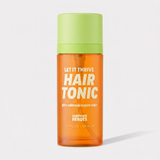
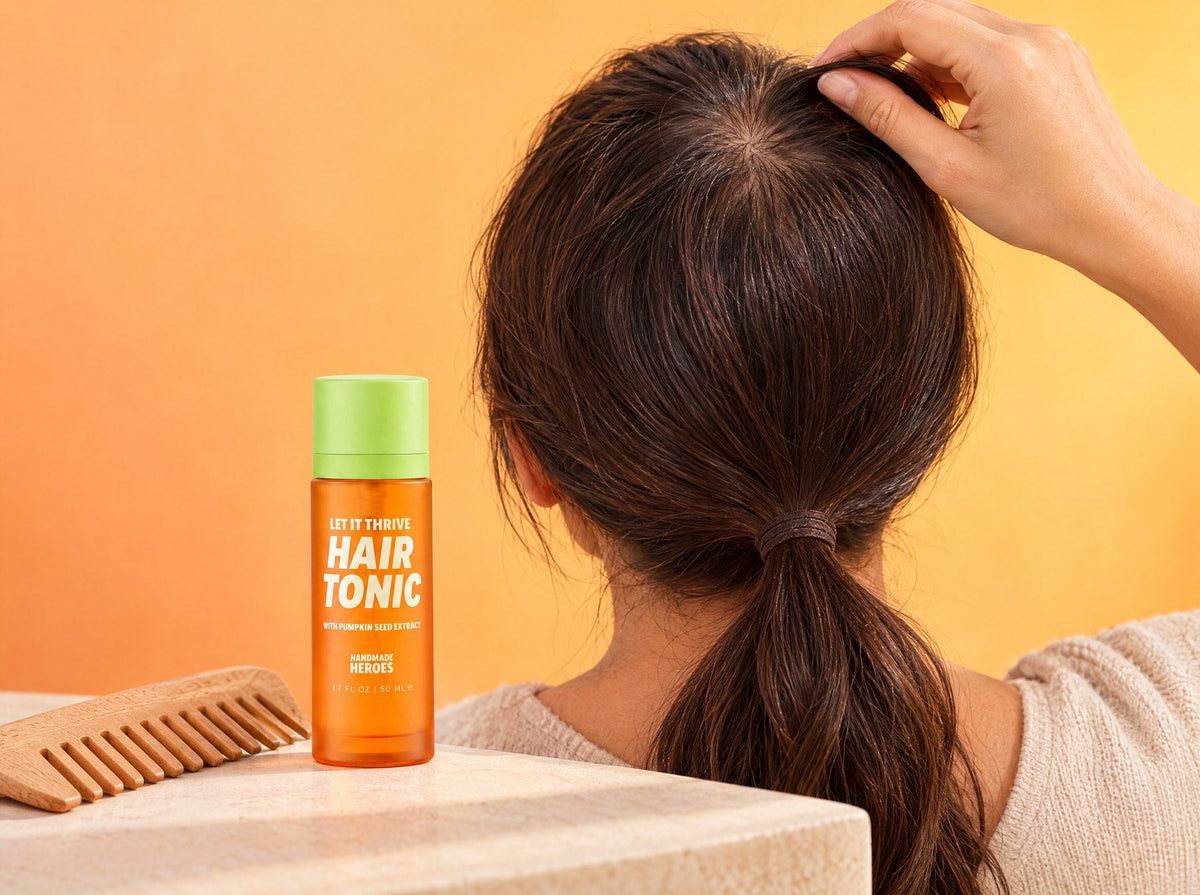
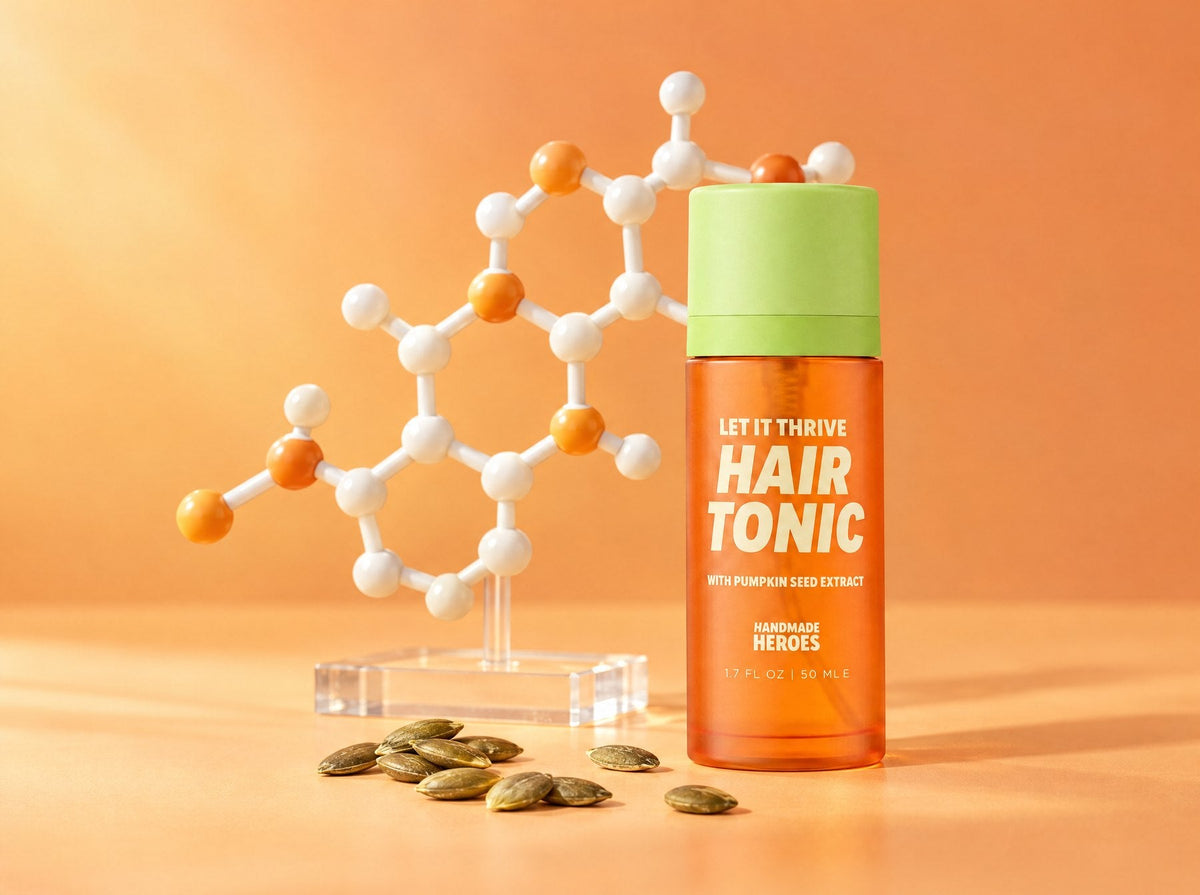
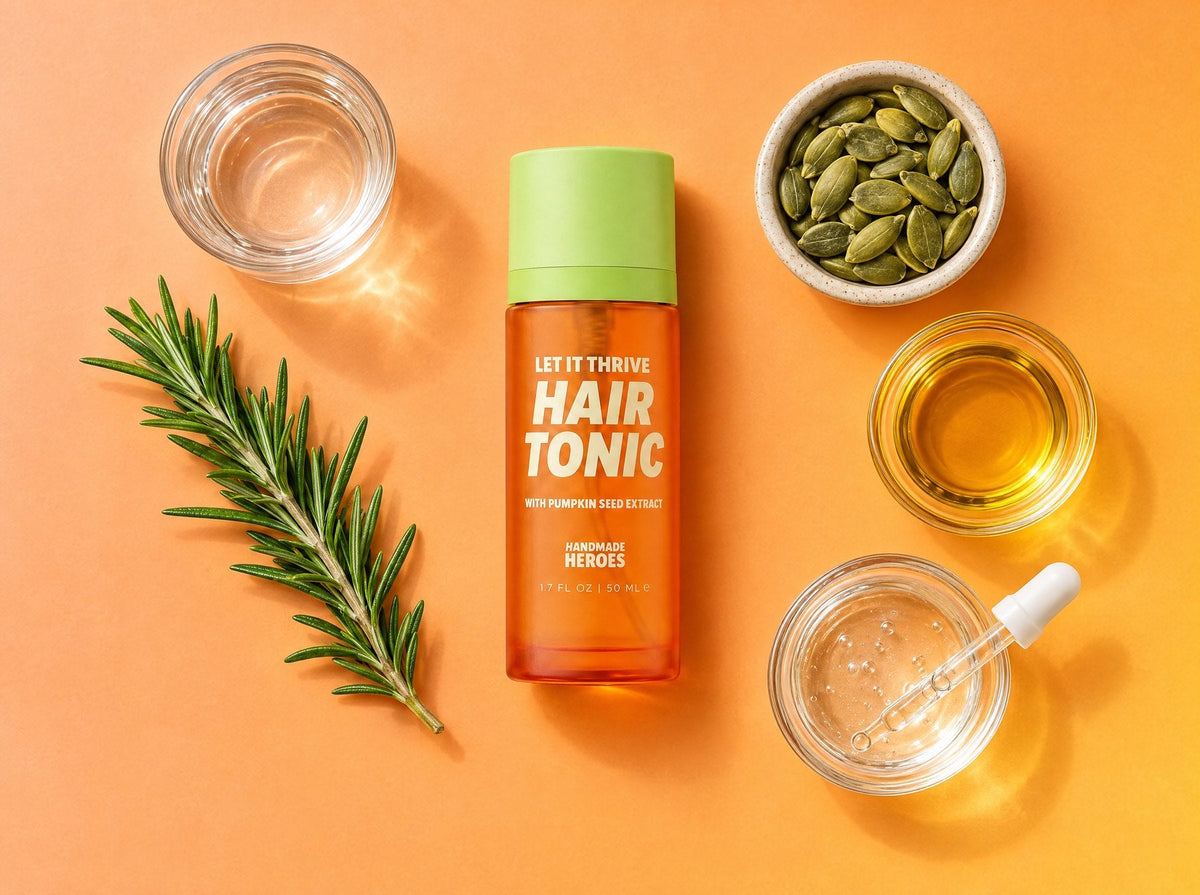
No cosmetic can tell you why your hair is thinning, so start with a dermatologist. Alongside that, a daily scalp routine is something you can do yourself. Our Let It Thrive Hair Tonic is a lightweight leave-in that absorbs fast with no greasy residue, with pumpkin seed extract (listed on the label as Cucurbita pepo (pumpkin) seed oil) and rosemary leaf extract. It helps the scalp feel balanced, refreshed and healthy-looking and, with regular use, supports the appearance of fuller, thicker-looking hair. It's 100% naturally derived and vegan, with no minoxidil, no prostaglandins and no biotin.
Honest caveat, because we don't do hype: we chose pumpkin seed and rosemary because of the research behind them, which you can read in our pumpkin seed oil explainer and, for the studies in women, Pumpkin Seed Oil for Women's Thinning Hair. That research isn't a promise about our tonic, which is a cosmetic conditioning tonic, not a hair-loss treatment.
Start a daily scalp routine while you get answers — shop the Let It Thrive Hair Tonic.
When to see a professional
See a board-certified dermatologist if:
- your part is widening or your ponytail is thinning and you haven't had a diagnosis
- hair loss is sudden or patchy, which can be alopecia areata, or your scalp is painful, red or scarred
- your hairline is receding in a band or your eyebrows are thinning, which can be frontal fibrosing alopecia
- thinning comes with irregular periods, acne, extra facial hair or fatigue, which can point to PCOS, thyroid problems or iron deficiency
- shedding started after a new medication (don't stop it yourself; ask your prescriber)
Early Signs of Thinning Hair FAQ
What does a widening part mean?
It's a classic early sign of female pattern hair loss, in which hair on top thins while the front hairline mostly stays put (Ho et al., 2024). Other causes can look similar, so it's worth getting a dermatologist's diagnosis (American Academy of Dermatology).
At what age does female pattern hair loss start?
For most women it begins in midlife, in their 40s, 50s or 60s, but it can start earlier (American Academy of Dermatology).
Can thinning hair in women grow back?
It depends on the cause. Shedding after a trigger usually recovers on its own over time (Bergfeld and Mendez, 2026). For female pattern hair loss, the AAD says treatment can stop it worsening and help regrow hair, especially when started early (American Academy of Dermatology), though no one treatment works for everyone (American Academy of Dermatology). Scarring conditions are different: a scarred follicle can't grow hair again (American Academy of Dermatology).
Is a widening part always female pattern hair loss?
No. Other common causes of hair loss in women can look a lot like it, and each needs different treatment, which is why the AAD recommends a dermatologist's diagnosis before you treat it (American Academy of Dermatology).
Sources
- American Academy of Dermatology (2022). Thinning hair and hair loss: could it be female pattern hair loss? AAD.org. aad.org
- American Academy of Dermatology (n.d.). Hair loss: overview. AAD.org. aad.org
- American Academy of Dermatology (2022). Hair loss: diagnosis and treatment. AAD.org. aad.org
- American Academy of Dermatology (2022). Hair loss types: frontal fibrosing alopecia overview. AAD.org. aad.org
- Ho CH, Sood T, Zito PM (2024). Androgenetic alopecia. StatPearls. NCBI Bookshelf NBK430924
- Carmina E, Azziz R, Bergfeld W, Escobar-Morreale HF, Futterweit W, Huddleston H, et al. (2019). Female Pattern Hair Loss and Androgen Excess: A Report From the Multidisciplinary Androgen Excess and PCOS Committee. Journal of Clinical Endocrinology & Metabolism. PubMed 30785992
- Gupta AK, Teasell EM, Liddy A, Economopoulos V (2026). Scalp Microbiome Alterations in Androgenetic Alopecia: Patterns and Emerging Mechanistic Insights. International Journal of Dermatology. PMC13436231
- Ludwig E (1977). Classification of the types of androgenetic alopecia (common baldness) occurring in the female sex. British Journal of Dermatology. PubMed 921894
- Chaikittisilpa S, Rattanasirisin N, Panchaprateep R, Orprayoon N, Phutrakul P, Suwan A, et al. (2022). Prevalence of female pattern hair loss in postmenopausal women: a cross-sectional study. Menopause. PubMed 35357365
- Hughes EC, Syed HA, Saleh D (2024). Telogen effluvium. StatPearls. NCBI Bookshelf NBK430848
- Bergfeld WF, Mendez D (2026). Shedding: An updated guide to a common cause of hair loss. Cleveland Clinic Journal of Medicine. PubMed 42823125
- Treister-Goltzman Y, Yarza S, Peleg R (2022). Iron Deficiency and Nonscarring Alopecia in Women: Systematic Review and Meta-Analysis. Skin Appendage Disorders. PMC8928181
- Hussein RS, Atia T, Bin Dayel S (2023). Impact of Thyroid Dysfunction on Hair Disorders. Cureus. PMC10492440
- Paik JH, Yoon JB, Sim WY, Kim BS, Kim NI (2001). The prevalence and types of androgenetic alopecia in Korean men and women. British Journal of Dermatology. PubMed 11453914
Real ingredients. Real results.




Leave a comment
This site is protected by hCaptcha and the hCaptcha Privacy Policy and Terms of Service apply.