
TL;DR: Vitamin C is your skin’s antioxidant and collagen co-factor. Turmeric (specifically its active compound curcumin) brings anti-inflammatory and antioxidant action that supports a more even-looking complexion. Together they cover a lot of ground — brightness, protection, and tone — in one step. Here’s what the peer-reviewed literature actually says about each.
Vitamin C: more than just a brightening ingredient
Vitamin C (ascorbic acid) is one of the most researched ingredients in skincare, and for good reason. Your skin naturally concentrates vitamin C — levels in the dermis and epidermis are significantly higher than in blood plasma — which signals how fundamental it is to skin function. The science covers two main mechanisms:
- Antioxidant protection. Vitamin C is a potent free-radical scavenger. UV radiation generates reactive oxygen species that damage skin cells and collagen; vitamin C helps neutralize these before they cause structural harm.
- Collagen synthesis. Vitamin C is an essential co-factor for the enzymes that stabilize collagen. Without adequate vitamin C, collagen can’t be properly synthesized or maintained — and skin loses firmness over time.
A 2017 review in Nutrients by Pullar, Carr, and Vissers surveyed the evidence and concluded that vitamin C supports important skin functions by stimulating collagen synthesis and assisting antioxidant protection against UV-induced photodamage, and that topical application can meaningfully boost skin vitamin C concentrations (Pullar JM, Carr AC, Vissers MCM. Nutrients. 2017;9(8):866. PMC5579659).
Turmeric (curcumin): the brightening botanical
Turmeric has been used topically in South Asian and Southeast Asian skincare traditions for centuries. Its active compound, curcumin, is a polyphenol with documented antioxidant and anti-inflammatory properties in peer-reviewed literature. In skin terms, those properties support a more even-looking tone, a calmer-looking complexion, and protection against environmental stressors.
A systematic review published in Phytotherapy Research in 2016 analyzed 18 studies on turmeric and curcumin in human skin. Ten of those studies reported statistically significant improvement in skin conditions including facial photoaging in the turmeric/curcumin groups versus controls; the authors concluded there is early evidence that turmeric and curcumin products may benefit skin health (Vaughn AR, Branum A, Sivamani RK. Phytother Res. 2016;30(8):1243–1264. PMID: 27213821).
One practical note: turmeric oil (rather than raw curcumin powder) has better skin compatibility and a more stable formulation profile, delivering curcuminoids to the skin surface without the bioavailability issues that limit oral curcumin.
Why the two work well together
Vitamin C and turmeric/curcumin both target free-radical damage — through complementary pathways. Vitamin C is a direct free-radical scavenger and a co-factor for structural proteins; curcumin works partly through modulation of inflammatory signalling and has antioxidant activity of its own. Together they offer broader-spectrum antioxidant support and complementary brightening, addressing both oxidative stress and the look of uneven tone.
In a face-oil format, both are delivered in a lipid vehicle that supports the skin barrier and suits the oil-soluble curcuminoids in turmeric root oil.
How we think about vitamin C and turmeric
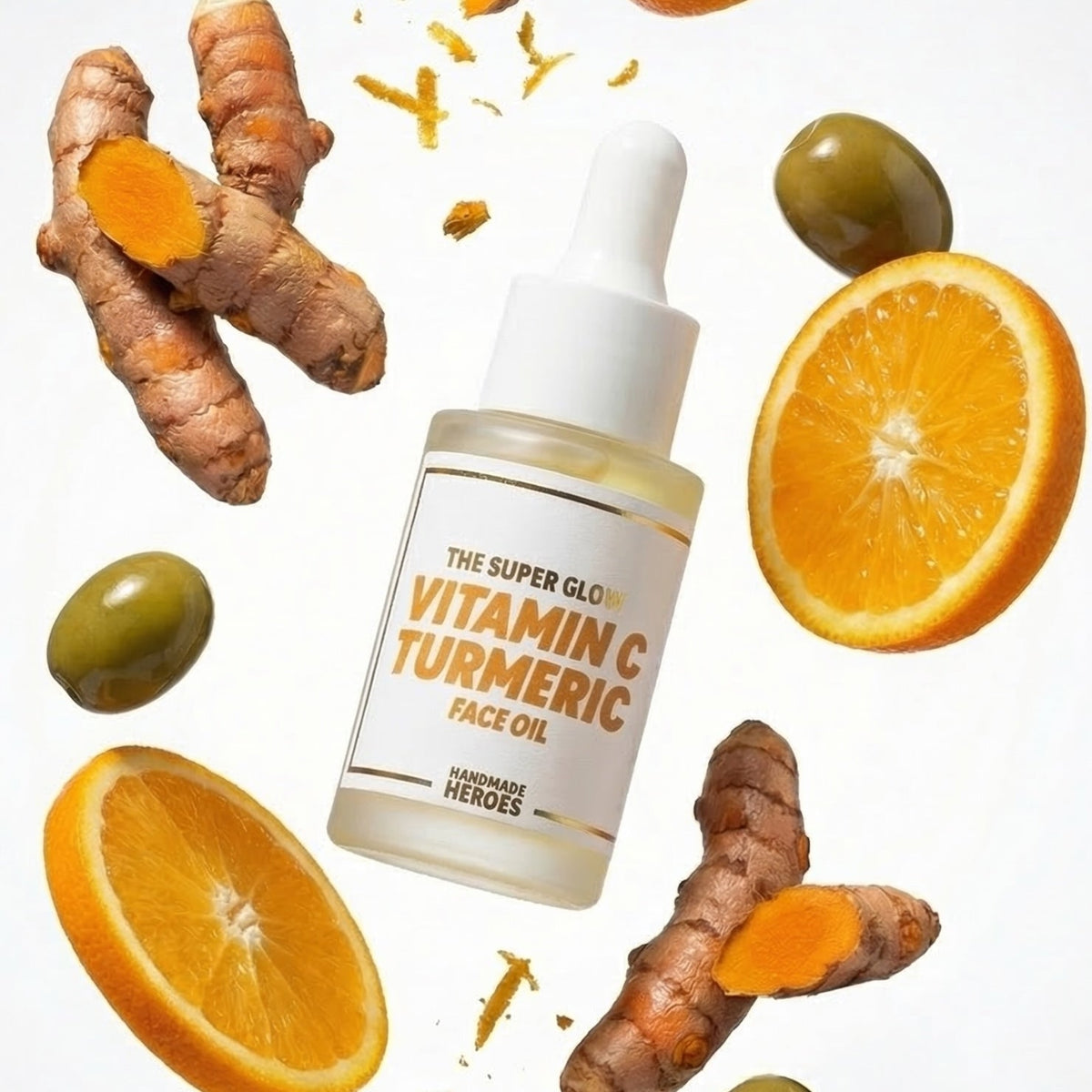
This vitamin-C-and-turmeric pairing — antioxidant protection plus a calmer, more even-looking tone — is exactly the thinking behind a brightening face oil: the two actives in a lightweight, skin-friendly base. As we expand our US range, you’ll find our current brightening and antioxidant picks in the face collection.
And because glow loves hydration, The Super Glow Vitamin C Turmeric Face Oil is a natural partner — layer it underneath for a hydration-plus-radiance routine, morning and night.
FAQ
Can vitamin C and turmeric be used together every day?
Yes — both are well tolerated by most skin types when used as directed in a properly formulated product. Vitamin C can occasionally cause tingling at higher concentrations; turmeric oil at cosmetic levels is generally well tolerated. Patch-test if you have reactive skin.
Will turmeric stain my skin yellow?
Raw turmeric powder can stain — but formulated turmeric root oil in a serum or face oil at cosmetic concentrations does not. The curcumin content is controlled and dispersed in a carrier oil, so you get the skin-benefit compounds without the yellow kitchen-counter effect.
Does vitamin C in skincare actually work topically?
Yes, with caveats. Stability is the main challenge — vitamin C oxidizes easily. Properly stabilized forms have good evidence for raising skin vitamin C levels and delivering measurable benefits; the Pullar et al. 2017 review specifically addresses topical application.
Are vitamin C and turmeric face oils okay for sensitive skin?
Generally yes, at cosmetic levels — but vitamin C can occasionally tingle at higher strengths, and any new active is worth a patch test first if your skin runs reactive. Look for lightweight, fragrance-free formulas.
Sources
- Pullar JM, Carr AC, Vissers MCM. The Roles of Vitamin C in Skin Health. Nutrients. 2017;9(8):866. pmc.ncbi.nlm.nih.gov/articles/PMC5579659
- Vaughn AR, Branum A, Sivamani RK. Effects of Turmeric (Curcuma longa) on Skin Health: A Systematic Review of the Clinical Evidence. Phytother Res. 2016;30(8):1243–1264. pubmed.ncbi.nlm.nih.gov/27213821
Real ingredients. Real results.

Leave a comment
This site is protected by hCaptcha and the hCaptcha Privacy Policy and Terms of Service apply.