
TL;DR: Vitamin C or turmeric for dark spots? Most articles make you pick a side. The honest answer is less of a competition and more of a division of labor — vitamin C is the better-studied pick for the look of brightness and tone, turmeric brings anti-inflammatory, calming action to the look of redness and irritation that often rides along with dark spots, and there's real research behind both. You don't actually have to choose.
What the research says about vitamin C and dark spots
Vitamin C's case for hyperpigmentation is one of the better-documented ones in cosmetic dermatology. A 2013 review in the Indian Dermatology Online Journal describes topical vitamin C as useful for treating hyperpigmentation, working in part by interfering with the enzyme pathway (tyrosinase) that drives melanin production (Telang PS. 2013;4(2):143–146). Earlier work by dermatologist Patricia Farris reached a similar conclusion, noting vitamin C's role in lightening the look of hyperpigmentation alongside its antioxidant and collagen-supporting effects (Farris PK. Dermatol Surg. 2005;31(7 Pt 2):814–817).
In practice, that translates to a cosmetic claim, not a medical one: formulated well, vitamin C can help brighten the look of dark spots and support a more even-looking tone over time. It doesn't erase pigment on contact, and it works gradually.
What the research says about turmeric and dark spots
Turmeric's angle is a little different. A systematic review in Phytotherapy Research analyzed 18 clinical studies on turmeric and its active compound, curcumin, and found consistent evidence for anti-inflammatory and antioxidant activity in skin, with several studies reporting improvement in measures of facial photoaging and skin appearance (Vaughn AR, Branum A, Sivamani RK. 2016;30(8):1243–1264). Curcumin's strength is calming — it's studied for soothing the look of redness and irritation, which matters because a lot of what reads as a "dark spot" on close inspection is actually inflamed, irritated skin sitting on top of or next to a pigmented patch.
That's an important distinction: turmeric isn't primarily positioned as a pigment-fading ingredient in the way vitamin C is. It's better understood as support for the look of redness and an overall calmer, more even-looking complexion alongside a brightening active.
So which one actually helps with dark spots?
Treated as a head-to-head, vitamin C has the deeper, more direct research base for the look of pigmentation specifically. But dark spots on real skin rarely show up alone — they're often paired with some redness, some post-breakout inflammation, some general unevenness. That's the case for using both rather than picking a winner: vitamin C working on the look of tone and brightness, turmeric working on the look of redness and calm, in the same routine.
This is cosmetic support for how skin looks, not a treatment for a diagnosed skin condition — and it's worth being direct about that distinction.
When a dark spot is more than a dark spot
Most dark spots are ordinary — sun exposure, healed breakouts, hormonal changes. But a spot that's new, changing shape or color, growing, or behaving differently from the pigmentation around it deserves an actual dermatologist's opinion rather than a new serum. The Cleveland Clinic notes that new pigmentation appearing later in life is worth having checked, since sun-exposed skin can develop changes that only a professional can properly evaluate. This article is general information, not medical advice.
Super Glow: vitamin C and turmeric in one bottle
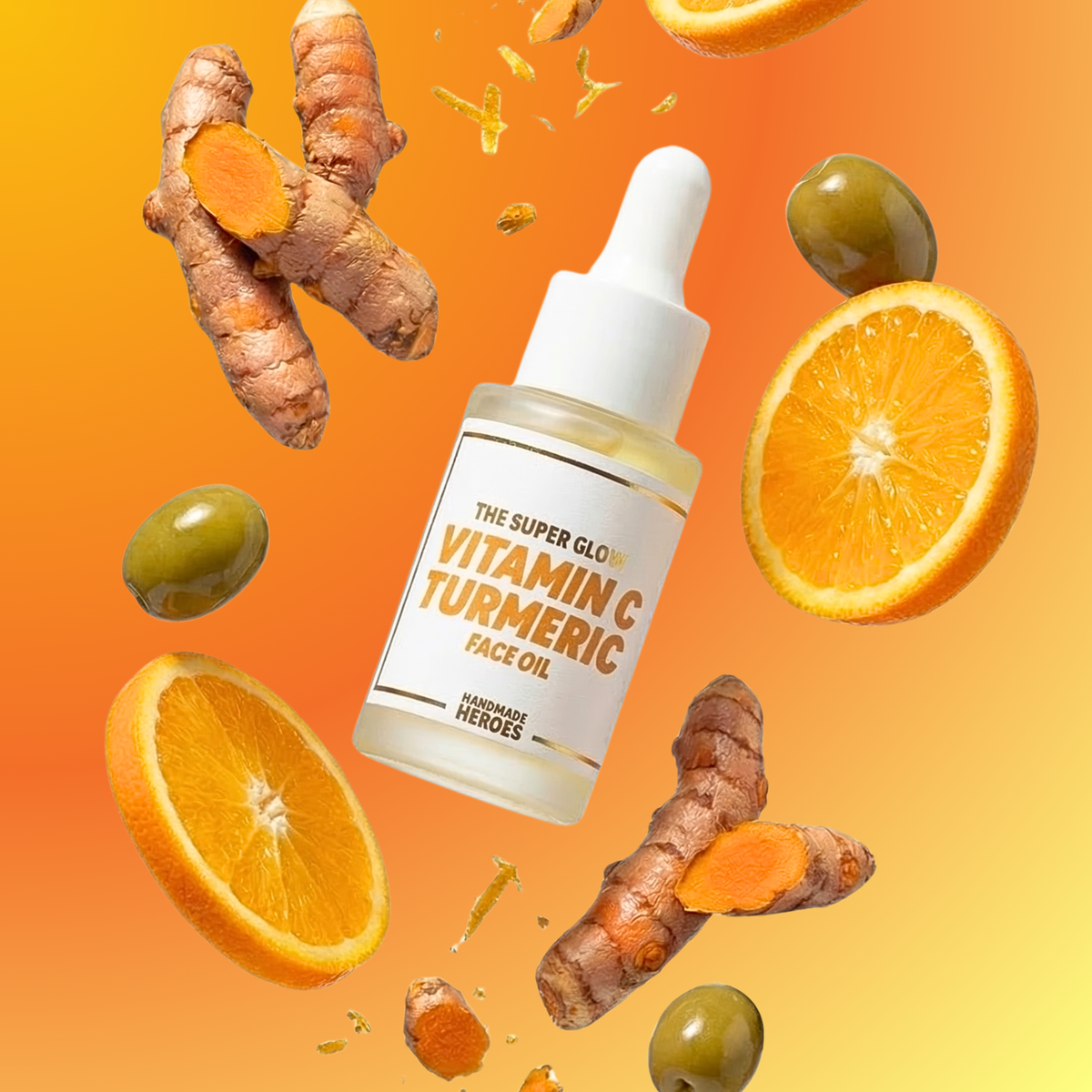
Rather than choosing between the two, The Super Glow Vitamin C Turmeric Face Oil pairs stable, oil-soluble vitamin C (tetrahexyldecyl ascorbate) with turmeric root oil in one short-ingredient-list formula — built to help brighten the look of dull, uneven-looking skin without needing a second bottle for the redness side of the equation. It's vegan, cruelty-free, and lab-formulated.
Shop The Super Glow Vitamin C Turmeric Face Oil
FAQ
Is turmeric or vitamin C better for dark spots?
Vitamin C has more direct research behind it for the look of pigmentation specifically. Turmeric's strength is calming the look of redness and inflammation that often accompanies dark spots. Used together, they cover more ground than either alone.
Can turmeric stain my skin if I use it in a face oil?
Formulated turmeric root oil at cosmetic concentrations in a proper formula is not the same as raw turmeric powder from the kitchen, and it's not intended to stain skin the way a DIY paste can.
How long before I see a difference in the look of dark spots?
Cosmetic brightening is gradual, typically measured in weeks of consistent use, not days. If a spot is changing, growing, or new, that's a conversation for a dermatologist rather than a timeline question for a serum.
Related reading
- The most stable form of vitamin C (it's not L-ascorbic acid)
- Turmeric skincare without the stain
- Dark lips: what actually helps
Sources
- Telang PS. Vitamin C in Dermatology. Indian Dermatology Online Journal. 2013;4(2):143–146. pmc.ncbi.nlm.nih.gov/articles/PMC3673383
- Farris PK. Topical Vitamin C: A Useful Agent for Treating Photoaging and Other Dermatologic Conditions. Dermatologic Surgery. 2005;31(7 Pt 2):814–817. pubmed.ncbi.nlm.nih.gov/16029672
- Vaughn AR, Branum A, Sivamani RK. Effects of Turmeric (Curcuma longa) on Skin Health: A Systematic Review of the Clinical Evidence. Phytotherapy Research. 2016;30(8):1243–1264. pubmed.ncbi.nlm.nih.gov/27213821
- Cleveland Clinic. Hyperpigmentation: What It Is, Causes & Treatment. my.clevelandclinic.org/health/diseases/21885-hyperpigmentation
Real ingredients. Real results.


Leave a comment
This site is protected by hCaptcha and the hCaptcha Privacy Policy and Terms of Service apply.