
Your jaw looks different at 7 a.m. than it does by noon — puffier, softer at the edges, a little tighter if you clench in your sleep. Here's what a gua sha routine can actually do about that, and what it can't.
Why your jawline looks puffier in the morning
Lying flat all night lets fluid pool along your jaw and under your chin, which is part of why your face can look softer and less defined first thing. A slow, outward gua sha motion follows the same one-direction path as lymphatic drainage massage, which Cleveland Clinic says may help get that fluid moving again and ease facial puffiness. They're careful to note this specific effect hasn't been directly studied, even though the logic holds up. The result, if it works for you, is a temporarily de-puffed look, not a structural change. It comes back the next morning, which is exactly why it's a ritual and not a one-time fix.
What the research found about the jaw specifically
A 2025 randomized controlled trial in the Journal of Cosmetic Dermatology is the most detailed look yet at gua sha and the jawline. Researchers had 34 women use either a facial roller or gua sha for 10 minutes a day, five days a week, for eight weeks — 40 sessions total. Using a 3D facial scanner, they tracked a jawline-specific surface measurement that dropped by 2.23 mm in the gua sha group (p < 0.001), in the same range as the study's other facial-contour measurements.
The more interesting finding for anyone who clenches all day: using a device that measures muscle tension directly on the masseter — the muscle you tighten when you grit your teeth — researchers found gua sha significantly reduced tension there: oscillation frequency down 2.02 Hz, dynamic stiffness down 56.46 N/m, while the facial-roller group showed no change. In plain terms, the outward strokes may make a tight, clenched jaw feel looser. That's a real, measured effect on muscle tension — not a claim about reshaping your jawbone.
Be honest about the limits
This was a small trial — 34 women, eight weeks, one specific research team — and the researchers themselves flagged that they didn't test whether the changes last beyond the study period. Gua sha does not melt fat, does not reshape your jawbone, and does not create a permanent lift. What it can do is offer a temporarily more defined-looking jawline and a looser-feeling jaw, and only with the kind of near-daily consistency the study used — not a single pass before an event.
When it's not about your gua sha
If your jaw actually hurts — aching, clicking, locking, or pain that lasts more than a week — that's outside what any massage tool can address. Cleveland Clinic is direct about it: jaw pain that sticks around is a reason to talk to a dentist or doctor, since clenching, grinding, and TMJ disorders sometimes need actual treatment, like a mouth guard or physical therapy. Jaw Drop is a feel-good ritual for a tired-feeling jaw, not a treatment for a painful one. Also skip it entirely over active breakouts, broken skin, sunburn, or irritation on the jawline.
Technique for the jaw, specifically
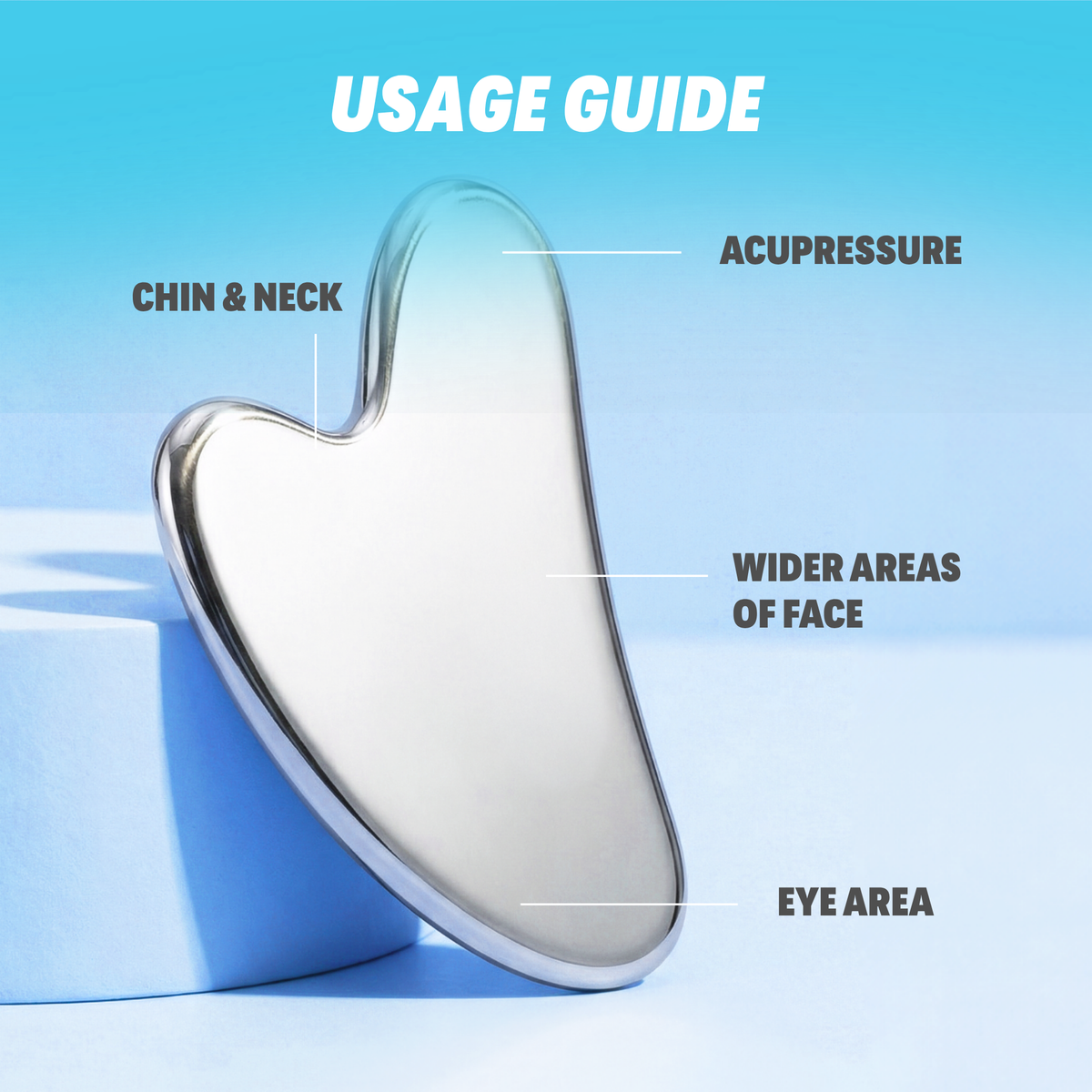
Hold the tool at a flat, shallow angle against damp, oiled skin — steep angles are what cause tugging. Start at the chin and sweep outward and slightly up toward the ear, following your jawbone, in light, slow passes. Three to five passes per side is enough. Never work it over bare, dry skin, and wash the tool after every use.
Meet the tool: Jaw Drop
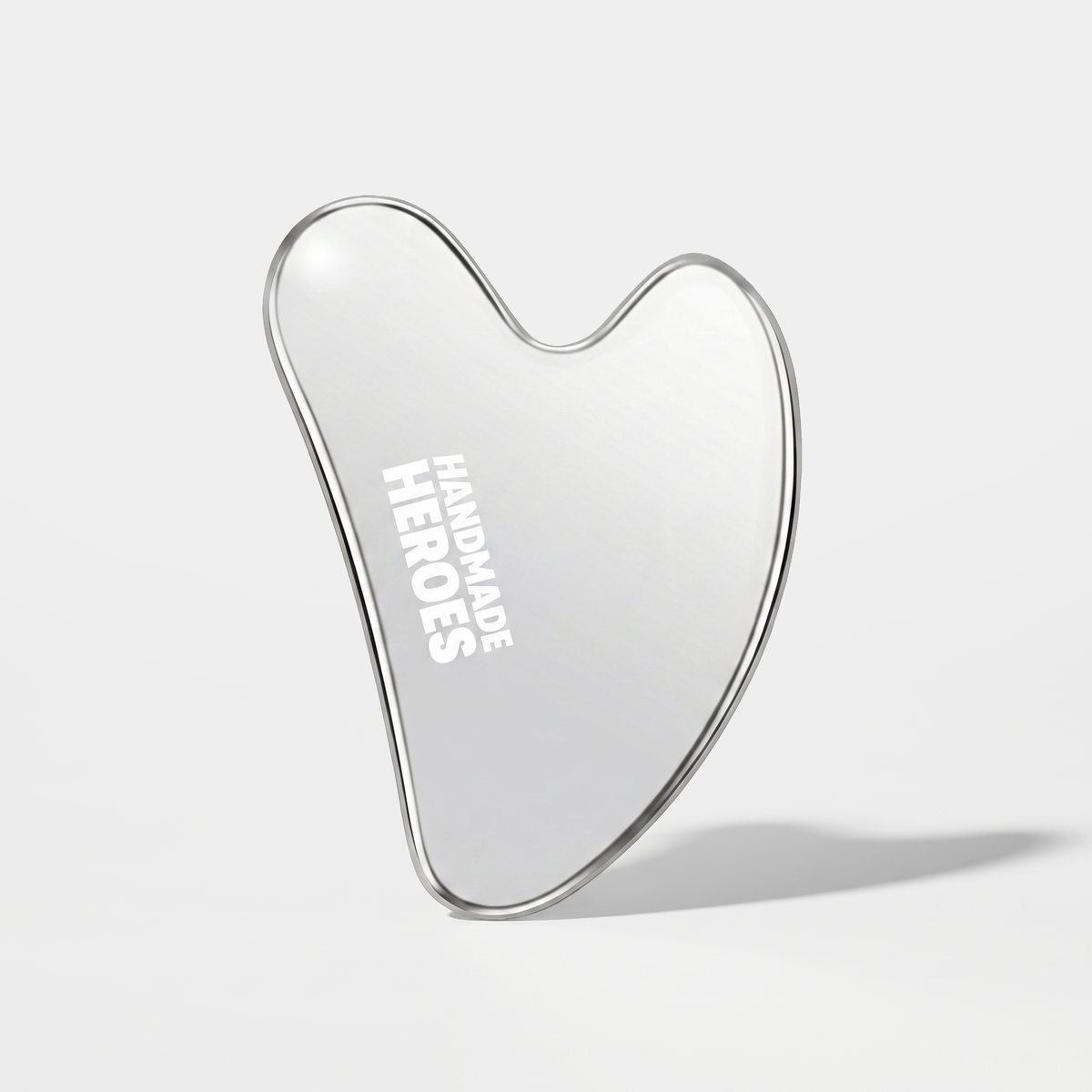
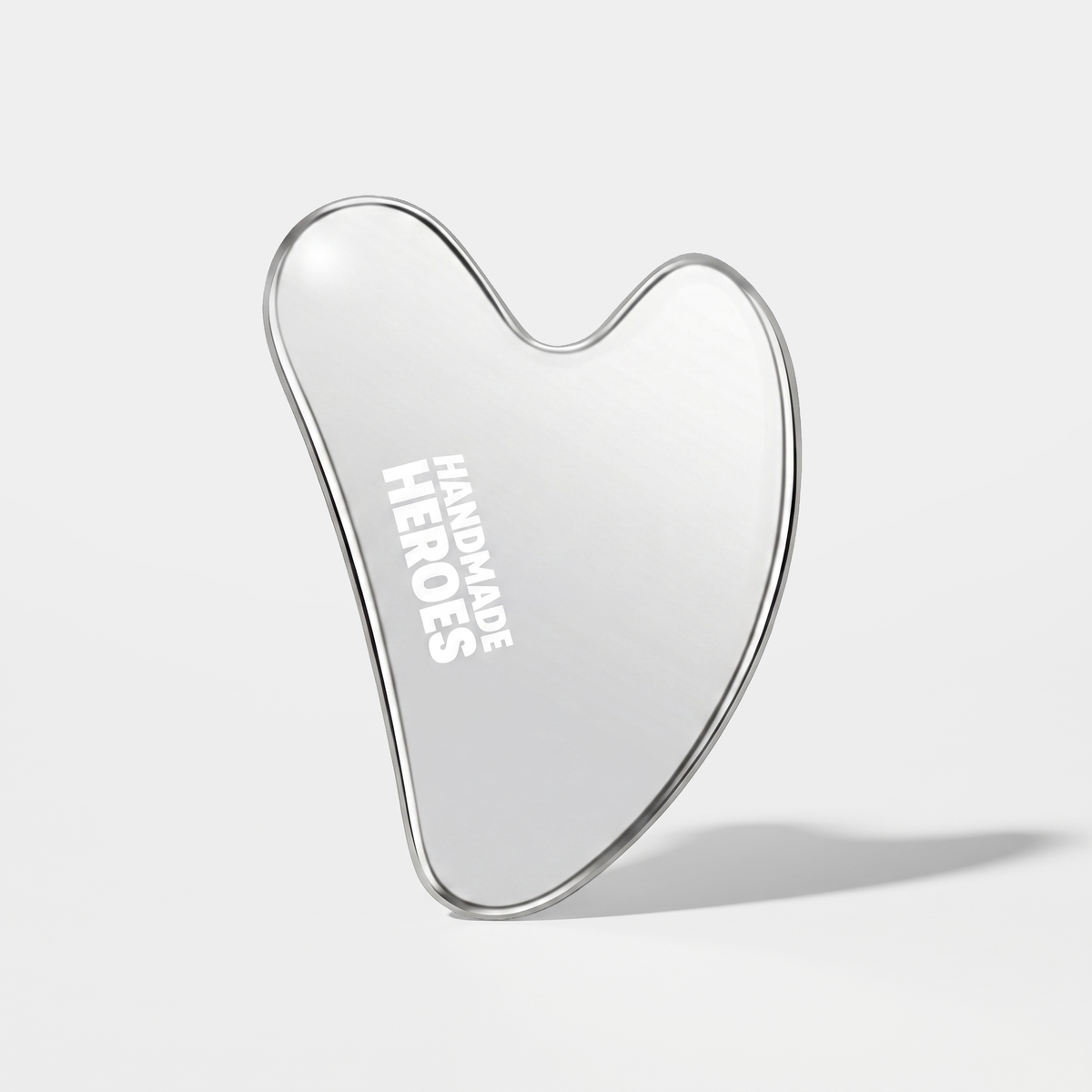
Jaw Drop is one sculpted piece of solid, food-grade 304 stainless steel, cool to the touch and colder straight from the fridge for an extra de-puffing sensation on a rough morning. The polished edges are smooth enough to glide over oiled skin without snagging, and because it's non-porous, it wipes fully clean in seconds and won't chip or shatter. Use a few drops of face oil first — the Bakuchiol Booster Oil or the Super Glow Vitamin C Oil both give it good glide — then sweep along your jaw as above. Shop the Jaw Drop Stainless Steel Gua Sha.
FAQ
Will gua sha permanently define my jawline?
No. The effect is temporary and appearance-level — a de-puffed, more defined-looking jaw that fades back over time, not a structural change.
Can it help a jaw that's tight from clenching?
It may help it feel looser — research found gua sha reduced measured tension in the jaw muscle. If your jaw actually hurts, see a dentist or doctor.
How long before I'd notice anything?
The research behind this used daily-ish sessions for eight weeks. Think ritual, not one-time fix.
Related reading
- Does Gua Sha Actually Work? An Honest Look at the Evidence
- Stainless Steel vs Jade or Rose Quartz Gua Sha: What Actually Matters
- How to Use a Gua Sha
Sources
Ahn S., Hwang U., Han H., et al. "Comparative Effects of Facial Roller and Gua Sha Massage on Facial Contour, Muscle Tone, and Skin Elasticity: Randomized Controlled Trial." Journal of Cosmetic Dermatology, May 2025. onlinelibrary.wiley.com/doi/10.1111/jocd.70236
Cleveland Clinic. "Gua Sha: What It Is and How To Do It." health.clevelandclinic.org
Cleveland Clinic. "Jaw Pain: Common Causes and How To Treat It." my.clevelandclinic.org
General information, not medical advice.
Real ingredients. Real results.

Leave a comment
This site is protected by hCaptcha and the hCaptcha Privacy Policy and Terms of Service apply.