
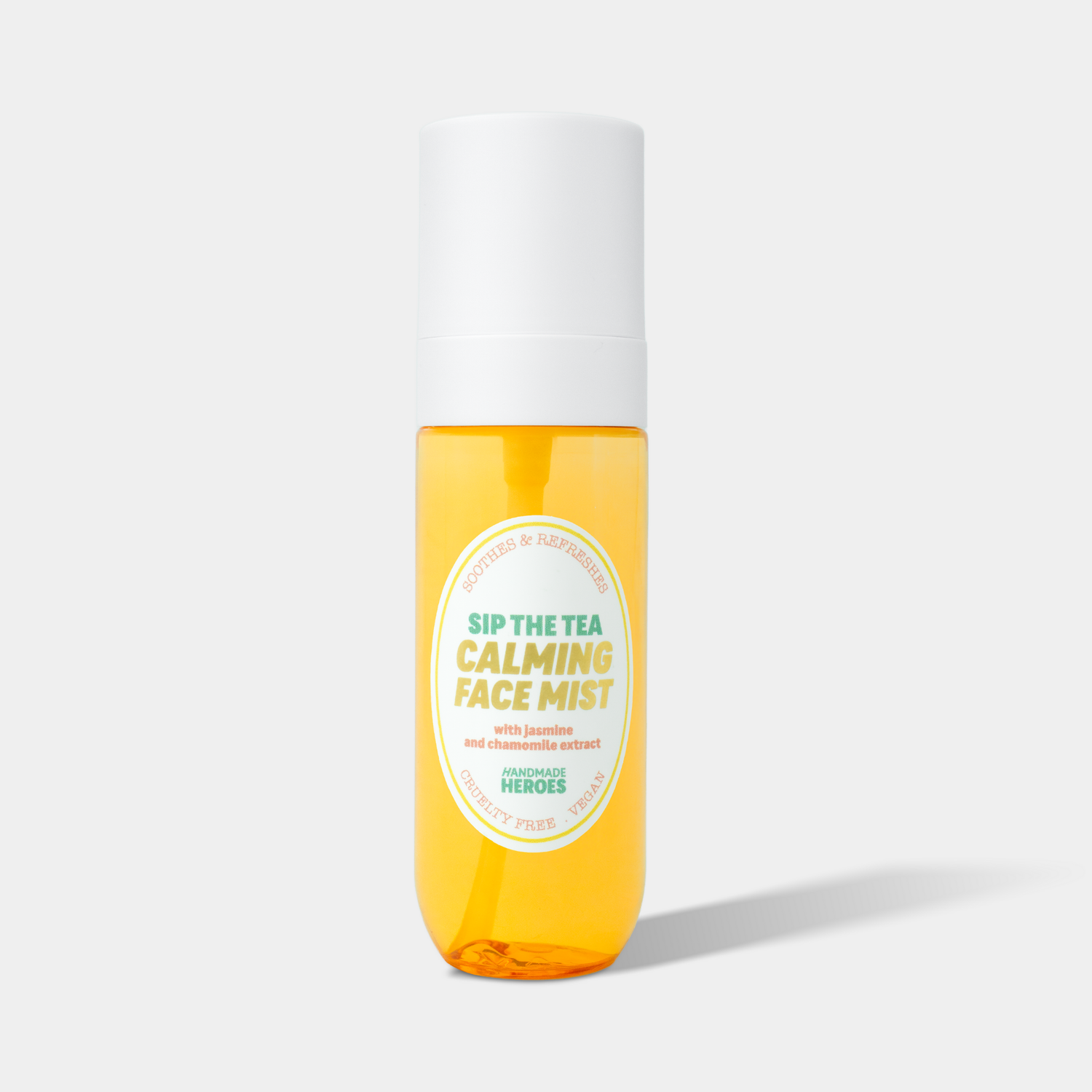
Twelve ingredients, one bottle, zero mystery. Here's the full ingredient list for Sip the Tea Calming Face Mist, grouped by what each one actually does.
The Base and the Calmers
Water (Aqua) is first on the ingredient list because water is most of what's in the bottle — that's simply how ingredient labeling works, listed in descending order by concentration. From there, two calming botanicals are steeped right into that base: Anthemis Nobilis (Roman Chamomile) Flower Water and Jasminum Officinale (Jasmine) Flower Extract.
Roman chamomile flower water is chamomile brewed into the actual water phase of the formula, not just used to perfume it. Chamomile has one of the longer track records in dermatology research of any botanical on this list — a 2026 review in the journal Applied Sciences walks through its antioxidant and anti-inflammatory activity, and how compounds like its flavonoids help support skin's redox balance. Jasmine flower extract is doing double duty here too: it's a botanical extract in the formula, and it's part of what gives the mist its signature scent.
The Hydrators
Four ingredients handle the water-binding work: Glycerin, Pentylene Glycol, Propanediol, and Hydrolyzed Sodium Hyaluronate.
Glycerin (a humectant — it pulls moisture toward skin and helps hold it there) is one of the most studied hydrating ingredients in cosmetic chemistry. Pentylene Glycol and Propanediol are plant-derived multi-taskers: both are humectants that also help the formula's other ingredients disperse evenly, so what lands on skin is consistent spritz to spritz.
Then there's hydrolyzed sodium hyaluronate — hyaluronic acid broken down into a lower molecular weight. Molecular weight is the whole game with HA: published research on hyaluronic acid and skin has shown that larger HA molecules mostly sit on the surface and hold water there, while a lower-molecular-weight, hydrolyzed form is small enough to move into the upper layers of skin instead of just resting on top. In a fine mist, rather than a heavy serum, that difference is the point — it's what lets this formula hydrate on contact instead of sitting on skin as a film you have to blend in.
The Keepers
Here's the part a lot of "clean beauty" marketing goes quiet on: Sodium Benzoate, Benzoic Acid, and Potassium Sorbate are a preservative system. We're not going to call this bottle preservative-free, because a water-based mist without one isn't a shelf-stable product — it's a science experiment in a bathroom cabinet. This trio is a well-established combination in cosmetic formulation, working together to keep the mist stable from the first spritz to the last.
Sodium Phytate is a chelator — it binds trace metals that can otherwise sneak in from water or packaging and destabilize a formula over time. Sodium Bicarbonate is there for pH, keeping the mist balanced so it feels calm on skin instead of tight or reactive.
Twelve ingredients. Nothing you can't pronounce with a straight face, and nothing hiding behind a catch-all "fragrance" line.
What It All Adds Up To
Sip the Tea Calming Face Mist is a fine, alcohol-free spritz — no sting, no sticky residue, no waiting around before makeup goes on over it. Chamomile flower water and jasmine flower extract calm the look and feel of skin; hydrolyzed sodium hyaluronate hydrates on contact; sodium benzoate, benzoic acid, and potassium sorbate keep the whole thing stable in the bottle. It comes in at 66 ml, and it's vegan and naturally derived.
Try it and see what twelve honestly-labeled ingredients feel like on your face.
FAQ
Is Sip the Tea Calming Face Mist alcohol-free?
Yes. It's formulated without alcohol, so there's no sting and no tight, dry-down feeling — just a cool, calming mist.
Can I use it over makeup?
Yes. The mist is fine enough to spritz over a full face of makeup without disturbing it, and it dries down without leaving residue.
Related reading
- Jasmine and Chamomile in Skincare: What They Actually Do
- Gel Mask vs Face Mist: Which Calming Step Does What?
- What Does a Face Mist Actually Do?
Sources
Gangemi, S., et al. "Exploring the Therapeutic Potential of Calendula and Chamomile in Dermatology: From Anti-Inflammatory and Antioxidant Properties to New Therapeutic Perspectives." Applied Sciences, vol. 16, no. 4, 2026, 1965. doi.org/10.3390/app16041965
Papakonstantinou, E., Roth, M., and Karakiulakis, G. "Hyaluronic Acid: A Key Molecule in Skin Aging." Dermato-Endocrinology, vol. 4, no. 3, 2012, pp. 253–258. doi.org/10.4161/derm.21923
Real ingredients. Real results.


Leave a comment
This site is protected by hCaptcha and the hCaptcha Privacy Policy and Terms of Service apply.