































Pumpkin seed oil
Cucurbita Pepo (Pumpkin) Seed Oil
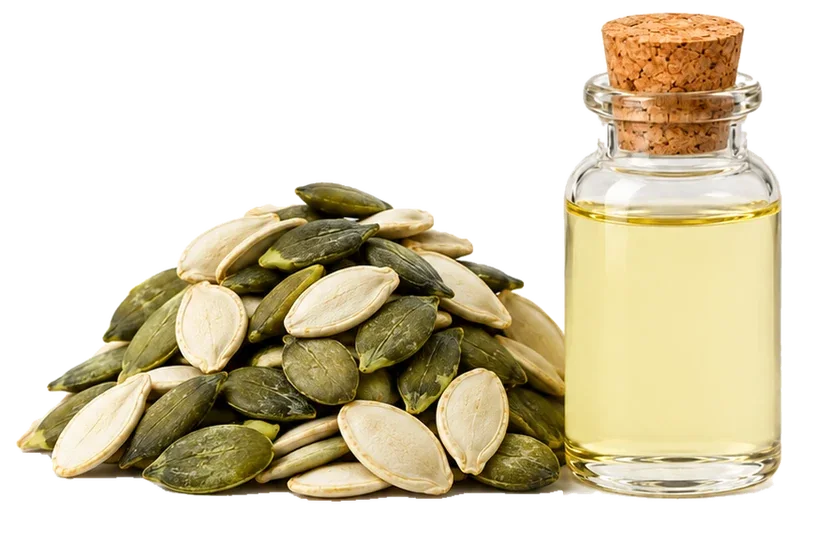
Pumpkin seed oil is a plant oil pressed from pumpkin seeds, rich in linoleic and oleic acids plus vitamin E, that cosmetics use as an emollient
The short version
- Pressed from the seeds of the pumpkin plant, Cucurbita pepo
- Linoleic, oleic, stearic and palmitic acids make up over 95% of its fats
- Naturally carries vitamin E and carotenoids
- Officially an emollient and skin-conditioning ingredient in the EU
The good
- A US CIR panel found pumpkin seed oil safe as used in cosmetics.8
- The EU lists it as an emollient and skin conditioner.1
The not so good
- Antioxidant evidence comes mostly from lab tests.6
- Pumpkin variety and extraction method change the oil's composition.5
The origin story
Pumpkin seed oil comes from pumpkin seeds and has a history as a food oil.610
In Styria, the thin-coated oil pumpkin appeared in the 1800s, though reviews disagree on when: one says the first half of the century, while another favors 1870–1880.1011 Those thin-coated seeds saved the work of peeling.1011 By 2023, pumpkin seed oil was also used in cosmetics.6712
What is pumpkin seed oil?
Pumpkin seed oil is exactly what it sounds like: oil pressed out of the seeds of the pumpkin plant, Cucurbita pepo.1
Pumpkin seeds are oily little things, with 42.3% of their weight coming from oil in one analysis, the highest of the seeds, grains and legumes tested.3
It's a common product in Slovenia, Hungary and Austria. In commercial oils studied, how hard the crushed seeds were roasted shaped the oil's aroma.2 Cosmetics use it too.6
What's in pumpkin seed oil?
Pumpkin seed oil is mostly fatty acids.
Four of them, linoleic, oleic, stearic and palmitic acid, make up more than 95% of the total, and about 75% of the fats are unsaturated.4 Linoleic acid usually comes out on top.5
The supporting cast:
One bottle isn't the same as the next, though. Pumpkin variety and extraction method both change the oil's makeup.5
What does pumpkin seed oil do in cosmetics?
On the official list, pumpkin seed oil is an emollient and a skin-conditioning ingredient, meaning it softens and keeps skin in good shape.1
A US safety review of plant oils says oils like this one are used for their skin conditioning, occlusive, emollient and moisturizing properties.8
It also behaves in a formula. In a lab study, a cream made with 20% pumpkin seed oil, vitamin E oil and beeswax stayed physically and microbiologically stable for 12 weeks, even when stored at 40 °C.7
What's still unknown about pumpkin seed oil
Quite a lot about pumpkin seed oil is still unknown.
Its antioxidant reputation comes mostly from lab tests: a 2022 review says most studies were done in vitro, and those support antioxidant and antimicrobial activity.6 Lab dish, not a lash line.
Its official functions are about skin, not hair.1
Is pumpkin seed oil safe?
The Cosmetic Ingredient Review Expert Panel, a US review panel, concluded in 2017 that pumpkin seed oil is safe as used in cosmetics.
That conclusion covered the 244 plant oils it assessed, pumpkin seed oil among them. Because many of these oils are edible and their whole-body toxicity potential is low, the panel focused on effects on skin.8 The EU lists no restrictions for it.1
Pumpkin seed allergy from eating the seeds is rare but can be severe, according to a 2026 case series of 25 children.9 That research is about food, not skin. If your skin reacts to a product with the oil, stop using it and check in with a dermatologist.
Questions people ask
What is pumpkin seed oil rich in?
Pumpkin seed oil is rich in fatty acids, mainly linoleic, oleic, stearic and palmitic, which together make up more than 95% of its fats.4 It also carries vitamin E and carotenoids.2
Is pumpkin seed oil good for hair?
Pumpkin seed oil's official cosmetic jobs are emollient and skin conditioning.1 A 2023 review says it's used in hair conditioners.12
Is pumpkin seed oil safe in cosmetics?
Pumpkin seed oil was included in a 2017 review of 244 plant oils by a US expert panel, which concluded they're safe as used in cosmetics.8
Is pumpkin seed oil an antioxidant?
Pumpkin seed oil contains antioxidants like vitamin E and carotenoids.2 Evidence that the oil acts as an antioxidant comes mostly from lab studies, not from people.6
Can you use pumpkin seed oil if you're allergic to pumpkin seeds?
Pumpkin seed food allergy is rare but can be severe.9 If you have it, ask your doctor or a dermatologist before using products with the oil.
Find it in
- let it thrive eyebrow serum $24.99
- let it thrive eyelash serum $24.99
- let it thrive hair tonic $39.99
Related ingredients
Back to the listSources
Show all 12 sources
- European Commission. CosIng cosmetic ingredient database: Cucurbita Pepo Seed Oil. Open source
- Procida G, Stancher B, Cateni F, Zacchigna M. Chemical composition and functional characterisation of commercial pumpkin seed oil. Journal of the Science of Food and Agriculture. 2013;93(5):1035–1041. Open source
- Ryan E, Galvin K, O'Connor TP, Maguire AR, O'Brien NM. Phytosterol, squalene, tocopherol content and fatty acid profile of selected seeds, grains, and legumes. Plant Foods for Human Nutrition. 2007;62(3):85–91. Open source
- Kassa MG, Teferi DA. Phytochemical Composition, Health Benefits, Functional Properties, and Food Applications of Pumpkin Seeds. Food Science & Nutrition. 2026;14(5):e71868. Open source
- Hu Z, Hu C, Li Y, Jiang Q, Li Q, Fang C. Pumpkin seed oil: a comprehensive review of extraction methods, nutritional constituents, and health benefits. Journal of the Science of Food and Agriculture. 2024;104(2):572–582. Open source
- Šamec D, Loizzo MR, Gortzi O, et al. The potential of pumpkin seed oil as a functional food: A comprehensive review of chemical composition, health benefits, and safety. Comprehensive Reviews in Food Science and Food Safety. 2022;21(5):4422–4446. Open source
- Ong TS, Chu CC, Tan CP, Nyam KL. Preparation and Evaluation Pumpkin Seed Oil-based Vitamin E Cream Formulations for Topical Application. Journal of Oleo Science. 2020;69(4):297–306. Open source
- Burnett CL, Fiume MM, Bergfeld WF, et al. Safety Assessment of Plant-Derived Fatty Acid Oils. International Journal of Toxicology. 2017;36(3 Suppl):51S–129S. Open source
- Acikalin B, Ocak M, Sekerel BE. Immunoglobulin E-mediated pumpkin seed allergy in children: Case series and narrative review with a structured literature search. Allergy and Asthma Proceedings. 2026;47(4):e50–e56. Open source
- Fruhwirth GO, Hermetter A. Seeds and oil of the Styrian oil pumpkin: Components and biological activities. European Journal of Lipid Science and Technology. 2007;109:1128–1140. doi:10.1002/ejlt.200700105. Published journal PDF hosted by a producer; only the paper, not host marketing, is evidence. Open source
- Teppner H. Notes on Lagenaria and Cucurbita (Cucurbitaceae) – Review and New Contributions. Phyton (Horn, Austria). 2004;44(2):245–308. Open source
- Wargala E, Chrzanowska A, Bernatek-Samoraj W, Kot I. Pumpkin (Cucurbita pepo L.) seed oil – cosmetic, food and medical raw material. Herba Polonica. 2023;69(3):7–14. doi:10.5604/01.3001.0053.8859. Open source