































Castor oil
Ricinus Communis (Castor) Oil, Ricinus Communis (Castor) Seed Oil
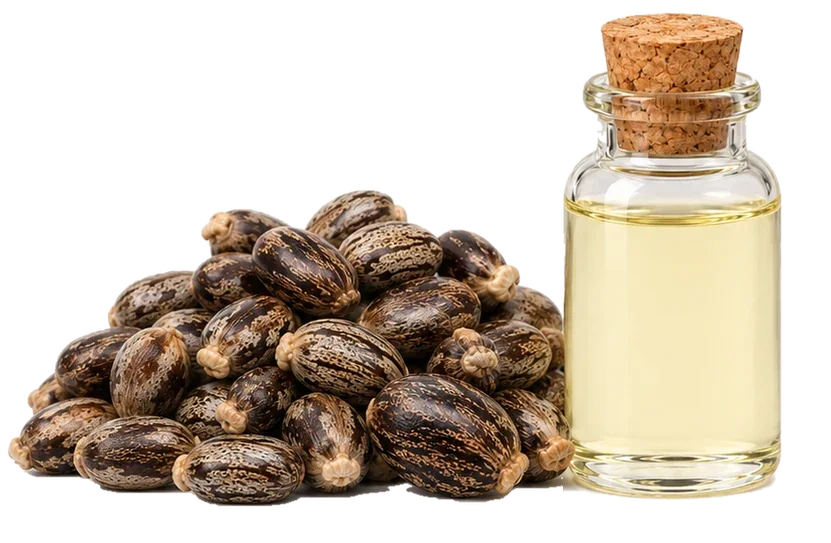
Castor oil is a thick oil pressed from castor seeds, up to 90% ricinoleic acid, that cosmetics use for skin conditioning
The short version
- Pressed from castor seeds; two label names, one oil
- Up to 90% ricinoleic acid, an unusual fatty acid
- The oil doesn't contain ricin, per a US safety panel
- Reported at up to 81% in lipsticks
- Found safe as used in 2007 and again in 2025
The good
- The US CIR panel found it safe as used and reaffirmed that conclusion in 2025.12
- The safety panel lists skin conditioning among its main cosmetic functions.1
The not so good
- Allergic lip reactions have been reported in hospital patients tested for lip inflammation.4
The origin story
Castor oil comes from the seeds of the castor plant, Ricinus communis, which are pressed to release the oil.13
In ancient Egypt, people cultivated castor and got the oil by pressing or boiling, then used it in lamps.67 Much later, castor oil appeared in lipstick formulas, mixed with colors for the lips.189
What is castor oil?
Castor oil is the oil from the seeds of the castor plant, Ricinus communis.1
It is made by cold pressing the seeds and then clarifying the oil with heat.1
Ricinus Communis (Castor) Seed Oil is the cosmetic naming convention for castor oil.1 The FDA's substance registry lists Ricinus Communis (Castor) Seed Oil and Ricinus Communis Oil under the same castor oil record.5
And the ricin question? The seed contains it, but the safety panel says castor oil doesn't, because ricin doesn't move into the oil.1
What makes castor oil different from other oils?
Castor oil's fatty acids are unusual.
It's up to 90% ricinoleic acid, with only about 4% linoleic and 3% oleic acid.3 Ricinoleic acid carries an extra hydroxyl group, which helps the oil resist oxidation and gives it a relatively long shelf life.3 It's also seriously thick: tested castor oil was more viscous than a standard SAE 40 engine oil.3
What does castor oil do in cosmetics?
The safety panel says castor seed oil and its relatives mainly work as skin-conditioning agents, emulsion stabilizers and surfactants.1
Its highest reported use level was 81%, in a lipstick.1
Is castor oil safe?
The Cosmetic Ingredient Review panel found castor oil safe as used in 2007.1
The panel wrote: "Castor oil is not a significant skin irritant, sensitizer, or photosensitizer in human clinical tests".1 A 2025 re-review kept that conclusion for castor seed oil.2
Allergy is uncommon but real. The 2007 report says sensitization is seen infrequently, though people with occupational skin conditions may react to castor oil or ricinoleic acid.1 In a review of patients patch-tested for lip inflammation at one Thai hospital, castor oil was among the most common allergens found (14.3%), and the authors called it an emerging allergen.4 If your lips or skin react, stop using it and check in with a dermatologist.
Questions people ask
Is Ricinus Communis Oil the same as castor seed oil?
Yes, Ricinus Communis Oil and castor seed oil are the same castor oil. The FDA's substance registry lists both names for the same castor oil.5 Ricinus Communis (Castor) Seed Oil is the standard cosmetic name.1
Does castor oil contain ricin?
No, castor oil doesn't contain ricin, according to a US safety panel, because ricin doesn't partition into the oil.1
Is castor oil safe on lips?
A US expert panel found castor seed oil safe as used in 2007, when its highest reported use was 81% in a lipstick,1 and kept that conclusion in 2025.2 Allergic lip reactions have been reported, and one hospital study counted it among the more common lip allergens in patch-tested patients.4
Why is castor oil so thick?
Castor oil is up to 90% ricinoleic acid, a fatty acid with an extra hydroxyl group, and it tests more viscous than SAE 40 engine oil.3
Find it in
- hyaluronic lip dew-classic $10.99
- hyaluronic lip dew-cottage core $10.99
- hyaluronic lip dew-mood $10.99
- let it thrive rosemary mint scalp & hair oil $14.99
- revive & renew foot cream $14.99
Related ingredients
- Olive oil
- Hydrogenated castor oil/sebacic acid copolymer
- Zinc ricinoleate
- Candelilla wax
- Sunflower seed oil
Sources
Show all 9 sources
- Cosmetic Ingredient Review. Final report on the safety assessment of Ricinus Communis (Castor) Seed Oil, Hydrogenated Castor Oil, Glyceryl Ricinoleate, Glyceryl Ricinoleate SE, Ricinoleic Acid, Potassium Ricinoleate, Sodium Ricinoleate, Zinc Ricinoleate, Cetyl Ricinoleate, Ethyl Ricinoleate, Glycol Ricinoleate, Isopropyl Ricinoleate, Methyl Ricinoleate, and Octyldodecyl Ricinoleate. International Journal of Toxicology. 2007;26(Suppl 3):31–77. Open source
- Fiume MM, Bergfeld WF, Belsito DV, Cohen DE, Klaassen CD, Rettie AE, Ross D, Snyder PW, Tilton SC, Heldreth B. Re-Review Summary of Ricinus Communis (Castor) Seed Oil and Ricinoleates as Used in Cosmetics. International Journal of Toxicology. 2025;44(3 Suppl):117S–122S. Open source
- Patel VR, Dumancas GG, Kasi Viswanath LC, Maples R, Subong BJ. Castor Oil: Properties, Uses, and Optimization of Processing Parameters in Commercial Production. Lipid Insights. 2016;9:1–12. Open source
- Kanokrungsee S, Likittanasombat S, Chaweekulrat P, Kumpangsin T, Boonchai W. Prevalence and causative allergens of contact cheilitis in Thailand. Contact Dermatitis. 2023;89(5):345–351. Open source
- National Center for Biotechnology Information. PubChem Substance Record: Castor oil, SID 472396953 (source: FDA Global Substance Registration System). Open source
- Sandy DB. The Production and Use of Vegetable Oils in Ptolemaic Egypt. Bulletin of the American Society of Papyrologists, Supplements 6. Atlanta: Scholars Press; 1989. pp. 38–42, 53. Open source
- Moreno García JC. Leather Processing, Castor Oil, and Desert/Nubian Trade at the Turn of the 3rd/2nd Millennium BC: Some Speculative Thoughts on Egyptian Craftsmanship. In: Miniaci G, Moreno García JC, Quirke S, Stauder A, editors. The Arts of Making in Ancient Egypt: Voices, Images, and Objects of Material Production 2000–1550 BC. Leiden: Sidestone Press; 2018. pp. 159–174. Open source
- Friedberg L. Cosmetic stick and the like. US Patent 2,566,722. Published September 4, 1951. Open source
- Hutchison RB, Mores LR. Polyglycerol partial esters and their use in lipstick formulations. US Patent 3,890,358. Published June 17, 1975. Open source