































Tamarind seed polysaccharide
Tamarindus Indica Seed Polysaccharide
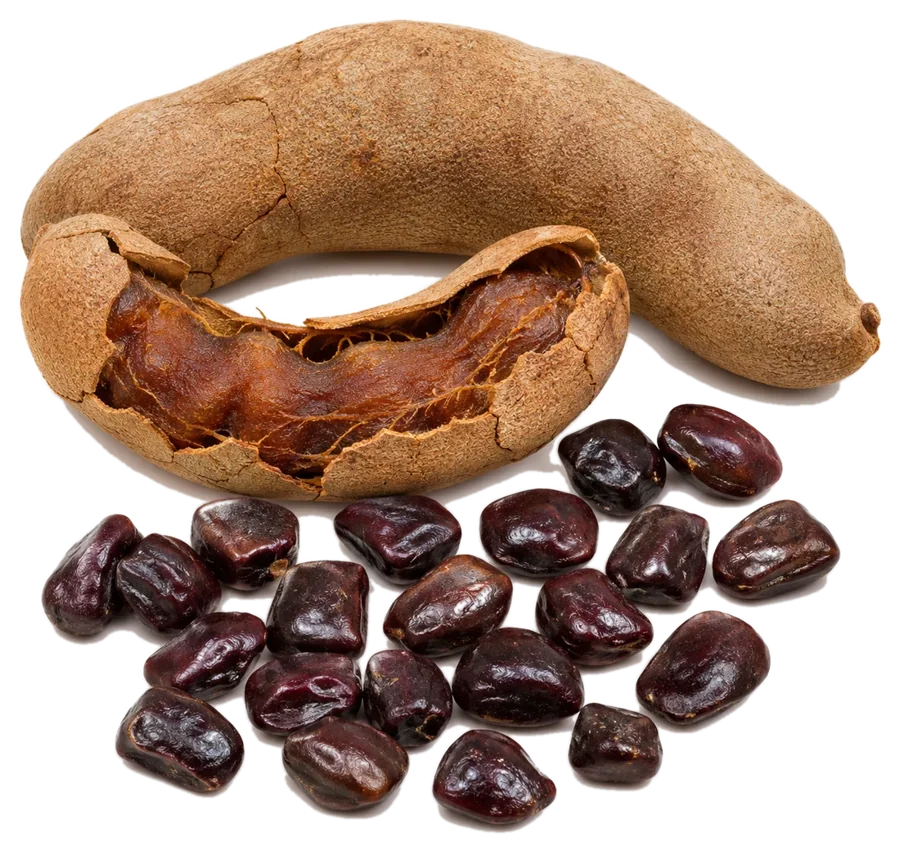
Tamarind seed polysaccharide is a big, branched sugar chain from tamarind seeds that the EU lists as a skin conditioner
The short version
- The polysaccharide fraction of tamarind tree seeds
- A galactoxyloglucan: a glucose backbone with xylose and galactose side chains
- Listed in the EU as a skin conditioning ingredient
- A 2013 skin-cell paper also cites earlier human skin research
- Food regulators gave it an acceptable daily intake of not specified in 2017
The good
- The EU lists skin conditioning as its cosmetic function.1
The not so good
- The saved abstract doesn't describe the moisturizing test method.5
- The reported moisture comparison used a chemically modified tamarind xyloglucan.5
The origin story
Tamarind seed polysaccharide comes from the seed kernels of Tamarindus indica, the tamarind tree.89
An older name for the polysaccharide was tamarind seed jellose.810 The seeds have also supplied preparations used for textile sizing.89 By 1999, tamarind seed extracts rich in xyloglycans had reached a patent for cosmetic or pharmaceutical products, with Gilles Pauly named as inventor.1112
What is tamarind seed polysaccharide?
Tamarind seed polysaccharide is the polysaccharide fraction of the seed of the tamarind tree, Tamarindus indica, a member of the legume family.1
Polysaccharide is science for a long chain of sugars, and this one is a big one.
Chemists call it a galactoxyloglucan. In a 2020 structural analysis, it was made of glucose, xylose and galactose in a molar ratio of 3.1 to 1.7 to 1.0, with a molecular weight of 524.0 kDa.2 Picture a straight glucose backbone with short sugar branches sticking off it.2 You'll also see it called tamarind xyloglucan, since xyloglucan is the family it belongs to.4
What does tamarind seed polysaccharide do?
Tamarind seed polysaccharide has a single listed cosmetic job in the EU's ingredient database: skin conditioning.1
Food regulators know it better as a thickener, gelling agent, emulsifier and stabilizer.7
A 2025 review describes it as a biodegradable, mucoadhesive biopolymer and notes it's been used widely in food and medicines, with cosmetic formulas among its other uses.3 Researchers who study skin cells also note that tamarind xyloglucans turn up as cosmetic ingredients and as carriers for drugs.4
What the research says about tamarind seed polysaccharide
Tamarind seed polysaccharide research includes skin-cell experiments and work on a chemically modified version.45
The 2013 skin-cell paper also cites earlier human skin research on immune responses.4
Is tamarind seed polysaccharide safe?
Tamarind seed polysaccharide's safety picture comes from two angles.
In 2015, the US Cosmetic Ingredient Review panel assessed 106 polysaccharide gums used to thicken cosmetics and concluded most of them are safe as used.6 The report includes a related tamarind ingredient, Tamarindus Indica Seed Gum.6 The panel added that these molecules are so large that getting through the skin is unlikely.6
For eating, an international food-additive committee (JECFA) reviewed tamarind seed polysaccharide in 2017, found no toxicity in long-term rodent studies and set its acceptable daily intake as not specified.7 That's a food finding, not a skin one. If a product leaves your skin red, itchy or swollen, stop using it and check in with a dermatologist.
Questions people ask
What is tamarind seed polysaccharide in skincare?
Tamarind seed polysaccharide is the sugar-chain fraction of tamarind seeds, listed in the EU as a skin conditioning ingredient.1 Chemically it's a galactoxyloglucan built from glucose, xylose and galactose.2
Is tamarind seed polysaccharide an alternative to hyaluronic acid?
Tamarind seed polysaccharide is a different molecule from hyaluronic acid, a xyloglucan.2 A 2025 study's abstract reports a higher 12-hour "moisturizing rate" for a chemically modified tamarind xyloglucan than for sodium hyaluronate.5
Does tamarind seed polysaccharide hydrate skin?
Tamarind seed polysaccharide's sources here include a 2025 abstract on a chemically modified version.5 The abstract reports a moisturizing effect for a cream, but doesn't describe its test method.5 The 2013 paper here tested skin cells.4
Is tamarind seed polysaccharide safe?
For tamarind seed polysaccharide, a US panel found most of the polysaccharide gums it reviewed safe as used in cosmetics, and said these large molecules are unlikely to get through skin. The report includes a related tamarind ingredient, Tamarindus Indica Seed Gum.6 As a food additive, JECFA set its acceptable daily intake as not specified.7
Find it in
Back to the listRelated ingredients
- Hyaluronic acid (sodium hyaluronate)
- Glycerin
- Snow mushroom (tremella) polysaccharide
- Sclerotium gum
- Xanthan gum
Sources
Show all 12 sources
- European Commission. CosIng cosmetic ingredient database: Tamarindus Indica Seed Polysaccharide. Open source
- Zhang H, Zhao T, Wang J, Xia Y, Song Z, Ai L. An amendment to the fine structure of galactoxyloglucan from Tamarind (Tamarindus indica L.) seed. International Journal of Biological Macromolecules. 2020;149:1189–1197. Open source
- Chinta ML, Gandam PK, Sivasankar MV, Parcha SR. Tamarind (Tamarindus indica L.) Seed Polysaccharide: A promising biopolymer for drug delivery, wound healing, tissue engineering and beyond. Carbohydrate Research. 2025;552:109454. Open source
- Nie W, Deters AM. Tamarind Seed Xyloglucans Promote Proliferation and Migration of Human Skin Cells through Internalization via Stimulation of Proproliferative Signal Transduction Pathways. Dermatology Research and Practice. 2013;2013:359756. Open source
- Ning R, Feng C, Zhang F, Zong S, Jiang J. Synthesis and Characterization of Superhigh Moisturizing Carboxymethyl Tamarind Xyloglucan and Its Potential Application in Cosmetics. Biomacromolecules. 2025;26(3):1647–1658. Open source
- Johnson W Jr, Heldreth B; Cosmetic Ingredient Review Expert Panel. Safety Assessment of Polysaccharide Gums as Used in Cosmetics. Final Report. Cosmetic Ingredient Review; 2015. Open source
- Joint FAO/WHO Expert Committee on Food Additives (JECFA). Tamarind seed polysaccharide. 84th meeting, 2017. WHO Technical Report Series 1007. Open source
- Nexight Group. Tamarind Seed Gum: Technical Evaluation Report, Handling/Processing. Prepared for USDA Agricultural Marketing Service, National Organic Program. February 21, 2018. Open source
- Shukla AK, Bishnoi RS, Kumar M, Fenin V, Jain CP. Applications of Tamarind seeds Polysaccharide-based copolymers in Controlled Drug Delivery: An overview. Asian Journal of Pharmacy and Pharmacology. 2018;4(1):23–30. doi:10.31024/ajpp.2018.4.1.5. Open source
- Deguchi Y, Shiba T. Process for obtaining tamarind seed jellose. US Patent 3,287,350. Issued November 22, 1966. Open source
- Pauly G. Use of extracts of tamarind seeds rich in xyloglycans and cosmetic or pharmaceutical product containing such extracts. US Patent 5,876,729. Issued March 2, 1999. Open source
- Majeed M, Bammi RK, Sankaran N, Prakash S, Anand S, Gangadharan GK. Standardized method for recovering enriched Indian date extract (IDE), properties of IDE and applications thereof. US Patent Application US20080286387A1. Published November 20, 2008. Open source