































Sweet almond oil
Prunus Amygdalus Dulcis (Sweet Almond) Oil
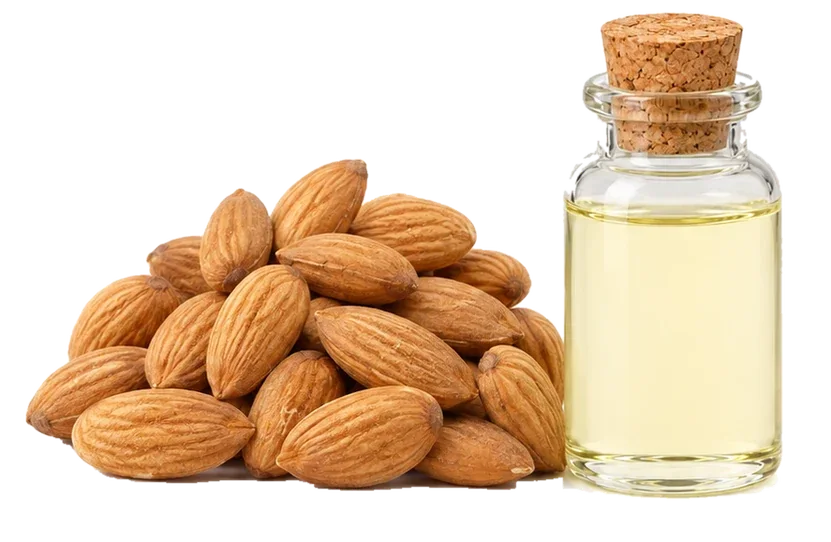
Sweet almond oil is an oil from sweet almond kernels, mostly oleic acid, that cosmetics use for skin conditioning
The short version
- The fixed oil from ripe sweet almond kernels
- Roughly three-quarters monounsaturated fat, mostly oleic acid
- Semi-occlusive: small studies found plant oils like it cut water loss
- One 16-week trial: similar wrinkle results to 0.025% tretinoin
- A US expert panel found it safe as used in cosmetics
The good
- Almond oil improved facial wrinkle severity over 16 weeks in a randomized trial with 79 completers.4
- The US CIR Expert Panel found sweet almond oil safe at reviewed cosmetic uses and concentrations.5
The not so good
- The Almond Board of California funded the wrinkle trial.4
- The wrinkle trial included only postmenopausal women with Fitzpatrick skin types I to III.4
The origin story
Sweet almond oil comes from almonds, which are pressed to release the oil.67
By the nineteenth century, almond oil was being mixed with rose water, white wax, spermaceti and rose perfume to make cold cream.68 Today, sweet almond oil is still used in many cosmetic products, including skin care preparations.79
What is sweet almond oil?
Sweet almond oil is the oil from the ripe kernels of the sweet almond tree, Prunus amygdalus var.
dulcis.1 The EU ingredient database lists its cosmetic job as skin conditioning.1
Most of it is oleic acid, at 53 to 78%, with 13 to 26% linoleic acid. Overall it's about 75% monounsaturated fat.2 People have used it in traditional remedies for a long time, though a 2010 review notes that no conclusive scientific data exists yet for its many claimed properties.3
What does sweet almond oil do for skin?
Sweet almond oil slows water from escaping, according to a 2022 review of small human studies.2
The review found plant oils, almond oil among them, were semi-occlusive: they lowered water loss or raised hydration in the outer skin within 30 minutes.2 In one test on six people, petrolatum still sealed better than any of the oils.2
What about all that oleic acid? The review found no significant skin benefit tied to almond oil's oleic-to-linoleic ratio, and concluded that healthy skin may not react badly to oils high in oleic acid.2
What the research says
One trial is a start, not a verdict, and it was on faces, not lips.4
Almond oil vs. tretinoinJournal of Cosmetic Dermatology, 2026
16-week randomized, double-blind trial · 90 postmenopausal women enrolled, 79 completed · almond oil, almond oil plus 0.5% vitamin E, or 0.025% tretinoin daily
All three groups had a significant drop in wrinkle severity by week 16, with no difference between them. Vitamin E added nothing for wrinkles. Melanin rose 4% in the almond-oil-only group.
Limits Funded by the Almond Board of California. No plain or untreated comparison group, and only Fitzpatrick skin types I to III took part.
Is sweet almond oil safe?
The Cosmetic Ingredient Review Expert Panel looked at 244 plant oils, and sweet almond oil is named on its list of ingredients found safe.5
The panel's verdict: safe in the present practices of use and concentration.5
If your skin or lips react, stop using it and check in with a dermatologist.
Questions people ask
Is sweet almond oil good for dry skin?
In small studies, sweet almond oil and other plant oils were semi-occlusive, cutting water loss or raising skin hydration within 30 minutes.2 Those studies were tiny and short.
Does almond oil help with wrinkles?
In one 16-week trial that enrolled 90 women, with 79 completing it, the sweet almond oil and 0.025% tretinoin groups all had a significant drop in the appearance of wrinkle severity, with no difference between them.4 It was funded by an almond industry group and had no plain comparison group.
Is sweet almond oil safe in cosmetics?
Yes, sweet almond oil is safe as used in cosmetics, according to the Cosmetic Ingredient Review panel, which found 244 plant oils safe as used.5
Find it in
- cocolicious luscious lip scrub - bakuchiol $11.99
- cocolicious luscious lip scrub - coconut sorbet $9.99
- cocolicious luscious lip scrub - matcha latte $9.99
- cocolicious luscious lip scrub - peppermint crush $9.99
- cocolicious luscious lip scrub - vitamin c & turmeric $12.99
- let it thrive rosemary mint scalp & hair oil $14.99
- mother of all lip oil - caramel chestnut $14.99
- mother of all lip oil - sugar peach $14.99
- mother of all lip oil - super glaze $14.99
- mother of all lip oil - sweet beet $14.99
- mother of all lip oil - vitamin c + turmeric $16.99
- oat mighty cuticle oil $9.99
- revive & renew foot cream $14.99
Related ingredients
Back to the listSources
Show all 9 sources
- European Commission. CosIng cosmetic ingredient database: Prunus Amygdalus Dulcis Oil. Open source
- Poljšak N, Kočevar Glavač N. Vegetable Butters and Oils as Therapeutically and Cosmetically Active Ingredients for Dermal Use: A Review of Clinical Studies. Frontiers in Pharmacology. 2022;13:868461. Open source
- Ahmad Z. The uses and properties of almond oil. Complementary Therapies in Clinical Practice. 2010;16(1):10–12. Open source
- Khan ZE, Lee A, Aguilar A, Adnan S, Afzal N, Sivamani RK. Prospective, Double-Blinded, Randomized Study of Topical Almond Oil and Tretinoin on the Appearance of Facial Wrinkles. Journal of Cosmetic Dermatology. 2026;25(11):e71279. Open source
- Burnett CL, Fiume MM, Bergfeld WF, et al. Safety Assessment of Plant-Derived Fatty Acid Oils. International Journal of Toxicology. 2017;36(3 Suppl):51S–129S. Open source
- Squire P. Companion to the Latest Edition of the British Pharmacopoeia. Ninth edition. London: J. & A. Churchill; 1873. Oleum Amygdalae, p. 38; Cold Cream, p. 86. Internet Archive OCR of the Royal College of Physicians of Edinburgh copy. Open source
- Axtell BL, from research by Fairman RM. Minor oil crops. FAO Agricultural Services Bulletin 94. Rome: Food and Agriculture Organization of the United Nations; 1992. Almond monograph. Open source
- Piesse GW Septimus. The Art of Perfumery, and Method of Obtaining the Odors of Plants. Philadelphia: Lindsay and Blakiston; 1857. Section XI, Cold Cream. Public-domain text reproduced in the downloaded PDF. Open source
- Blaak J, Staib P. An updated review on efficacy and benefits of sweet almond, evening primrose and jojoba oils in skin care applications. International Journal of Cosmetic Science. 2022;44(1):1–9. doi:10.1111/ics.12758. Abstract accessed through NCBI E-utilities. Open source