































Rosemary leaf extract
Rosmarinus Officinalis (Rosemary) Leaf Extract
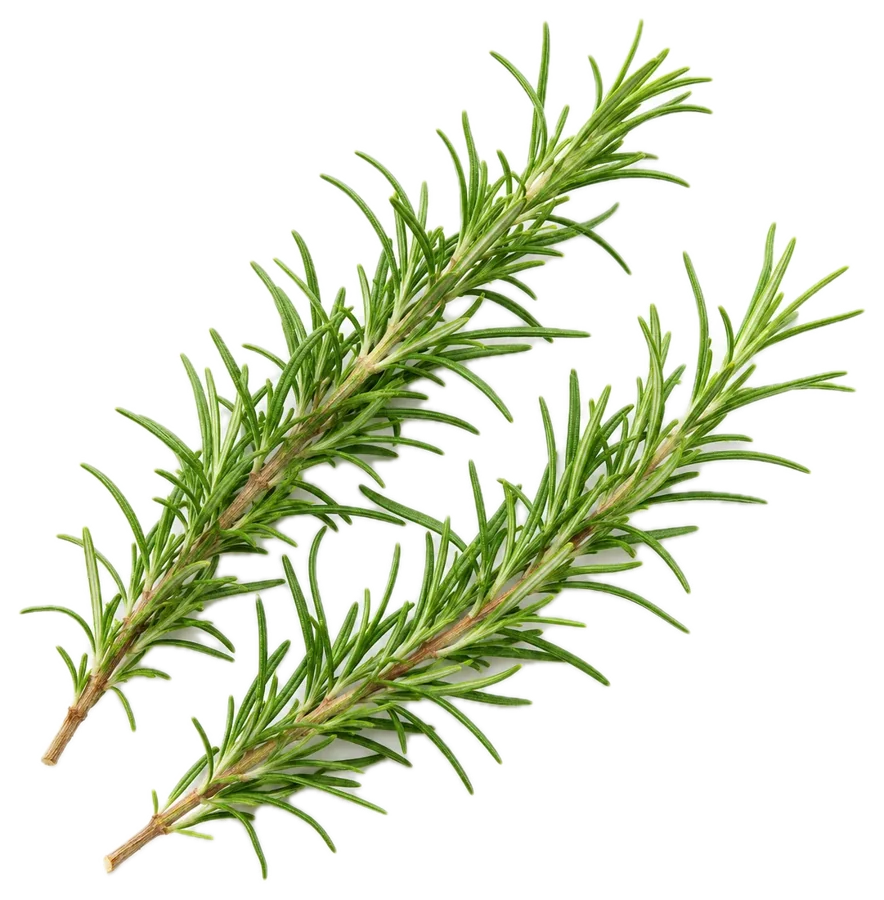
Rosemary leaf extract is an extract of rosemary leaves that cosmetics use for its antioxidant compounds, carnosic acid and carnosol
The short version
- Made from rosemary leaves with solvents like ethanol or CO2
- Main antioxidants: carnosic acid and carnosol
- Not the same ingredient as rosemary essential oil
- A US expert panel calls it safe when formulated to be nonsensitizing
- Allergic reactions are uncommon but have been reported
The good
- Company patch tests of formulas with up to 0.2% extract found no irritation or sensitization.1
- The US CIR panel found it safe as used when formulated to be nonsensitizing.1
The not so good
- The irritation-study abstract doesn't state the participant count or extract strength.4
- A case report traced a woman's facial reaction to rosemary leaf extract in a cleansing gel.5
The origin story
Rosemary leaf extract comes from the leaves of the rosemary plant, Rosmarinus officinalis, an evergreen shrub native to Mediterranean Europe.891011
In 1958, Scarpati and Oriente reported isolating rosmarinic acid, one of the compounds found in rosemary.1213 By 2005, rosemary extracts were being used in preparations that people applied to their skin.45
What is rosemary leaf extract?
Rosemary leaf extract is exactly what it sounds like: an extract of the leaves of rosemary, Rosmarinus officinalis, a member of the mint family.2
Yes, the same herb that ends up on roast potatoes. It's a scented evergreen shrub from the Mediterranean, and in the US it's generally recognized as safe as a food spice.1
To make the extract, leaves are soaked in solvents such as ethanol, acetone or hexane, or extracted with supercritical carbon dioxide. Some extracts then get deodorized and decolorized.1 That's why a rosemary extract doesn't always smell much like rosemary.
Rosemary extract vs. rosemary oil
Rosemary extract and rosemary oil come from the same plant but have different chemistry.
The extract's headline compounds are two phenolic diterpenes, carnosic acid and carnosol, which a US expert panel names as its main antioxidant components.1 Rosmarinic acid shows up too.3 One supplier even strips the essential oil out during production.1
How much carnosic acid and carnosol you get depends on the method: roughly 5% to 7% in a partially deodorized ethanol extract, and up to 30% in a CO2 extract.1 Growing season, plant variety and origin shift the recipe as well.1 Rosemary essential oil is a separate ingredient with its own page.
What does rosemary leaf extract do?
Rosemary leaf extract has three listed jobs in the EU's cosmetic ingredient database: antimicrobial, fragrance and skin conditioning.2
The US ingredient dictionary adds antioxidant to that list.1
The antioxidant part is well described in chemistry. In lab systems, carnosic acid and carnosol account for 90% of rosemary's antioxidant activity, and they slow down the oxidation of fats.3 The food world uses it as an antioxidant too: EU foods and drinks can contain rosemary extract at up to 400 mg/kg, counted as carnosic acid plus carnosol.3
What the research says
The chemistry is well described, and a US safety panel found it safe as used when formulated to be nonsensitizing.1
Skin irritated on purposeSkin Pharmacology and Physiology, 2005
Controlled irritation test · healthy volunteers · creams with marigold or rosemary extracts during 4 days of detergent exposure
All the test creams gave significant protection against the irritation. Rosemary creams beat the control on skin water loss, but that edge wasn't statistically significant. Using the creams afterwards did nothing.
Limits Abstract only. The saved abstract gives no participant count or extract strength, and it's not clear the extract matches the cosmetic ingredient.
Patch tests on finished productsInternational Journal of Toxicology, 2018 · 102 people
Industry patch tests summarized by an expert panel · 20 to 102 people per test · products with 0.0013% to 0.2% extract
Formulas with up to 0.2% rosemary leaf extract were not irritants or sensitizers.
Limits Unpublished company data and low concentrations.
Is rosemary leaf extract safe?
The Cosmetic Ingredient Review Expert Panel concluded in 2018 that rosemary leaf extract is safe as used when formulated to be nonsensitizing.1
That covers the present practices of use and concentration.1 Reported use levels ranged from 0.00001% up to 10%.1 Worth knowing: the panel is financially supported by the Personal Care Products Council.1
Allergy to rosemary does happen, just not often. A 2005 case report described a woman whose face reacted to a cleansing gel, and patch testing traced it to the rosemary leaf extract inside.5 Carnosol is one known trigger: a food-factory worker reacted to it in 1997, and other patients have tested positive to it.61 In one case report, a person allergic to rosemary also reacted to three of four related mint-family plants.7 If your skin turns red, itchy or swollen, stop using the product and check in with a dermatologist.
Questions people ask
What is the difference between rosemary extract and rosemary oil?
Rosemary extract is made with solvents or CO2 and is valued for its antioxidant diterpenes, carnosic acid and carnosol.1 One supplier reports stripping the essential oil out of its extract.1
Is rosemary extract an antioxidant?
Yes, rosemary extract is an antioxidant in chemistry terms. In lab systems, carnosic acid and carnosol account for 90% of rosemary's antioxidant activity.3
Is rosemary leaf extract safe for skin?
Rosemary leaf extract is safe as used in cosmetics when formulated to be nonsensitizing, a US expert panel concluded in 2018.1 Allergic reactions are uncommon but have been reported.5
Can you be allergic to rosemary extract?
Yes, case reports describe reactions to rosemary leaf extract and to carnosol, one of its main compounds.56 If a product makes your skin red or itchy, stop using it and see a dermatologist.
Find it in
- let it thrive eyebrow serum $24.99
- let it thrive eyelash serum $24.99
- let it thrive hair tonic $39.99
Related ingredients
Back to the listSources
Show all 13 sources
- Fiume MM, Bergfeld WF, Belsito DV, Hill RA, Klaassen CD, Liebler DC, Marks JG Jr, Shank RC, Slaga TJ, Snyder PW, Gill LJ, Heldreth B. Safety Assessment of Rosmarinus officinalis (Rosemary)-Derived Ingredients as Used in Cosmetics. International Journal of Toxicology. 2018;37(Suppl 3):12S–50S. Open source
- European Commission. CosIng cosmetic ingredient database: Rosmarinus Officinalis Leaf Extract. Open source
- Nieto G, Ros G, Castillo J. Antioxidant and Antimicrobial Properties of Rosemary (Rosmarinus officinalis, L.): A Review. Medicines (Basel). 2018;5(3):98. Open source
- Fuchs SM, Schliemann-Willers S, Fischer TW, Elsner P. Protective effects of different marigold (Calendula officinalis L.) and rosemary cream preparations against sodium-lauryl-sulfate-induced irritant contact dermatitis. Skin Pharmacology and Physiology. 2005;18(4):195–200. Open source
- Inui S, Katayama I. Allergic contact dermatitis induced by rosemary leaf extract in a cleansing gel. Journal of Dermatology. 2005;32(8):667–669. Open source
- Hjorther AB, Christophersen C, Hausen BM, Menné T. Occupational allergic contact dermatitis from carnosol, a naturally-occurring compound present in rosemary. Contact Dermatitis. 1997;37(3):99–100. Open source
- González-Mahave I, Lobesa T, Del Pozo MD, Blasco A, Venturini M. Rosemary contact dermatitis and cross-reactivity with other labiate plants. Contact Dermatitis. 2006;54(4):210–212. Open source
- United States Pharmacopeia. Rosemary Extract. Food Chemicals Codex. Rockville, MD: United States Pharmacopeia; 2014. doi:10.31003/FCC_F103781_07_01. Open source
- González-Minero FJ, Bravo-Díaz L, Ayala-Gómez A. Rosmarinus officinalis L. (Rosemary): An Ancient Plant with Uses in Personal Healthcare and Cosmetics. Cosmetics. 2020;7(4):77. doi:10.3390/cosmetics7040077. Open source
- Joint FAO/WHO Expert Committee on Food Additives. Evaluation of certain food additives: eighty-second report. WHO Technical Report Series 1000. Geneva: World Health Organization; 2016. Rosemary extract, p. 46. Open source
- Harris S. Rosmarinus officinalis L. (Lamiaceae): Rosemary. Oxford University Plants 400. University of Oxford, Department of Biology. Undated; accessed November 22, 2026. Open source
- Khojasteh A, Mirjalili MH, Alcalde MA, Cusido RM, Eibl R, Palazon J. Powerful Plant Antioxidants: A New Biosustainable Approach to the Production of Rosmarinic Acid. Antioxidants. 2020;9(12):1273. doi:10.3390/antiox9121273. Open source
- Al-Dhabi NA, Arasu MV, Park CH, Park SU. Recent studies on rosmarinic acid and its biological and pharmacological activities. EXCLI Journal. 2014;13:1192–1195. Guest editorial reviewing the literature. Open source