































Mineral salts (sodium, potassium and calcium chloride, magnesium sulfate)
Calcium Chloride, Magnesium Sulphate, Potassium Chloride, Sodium Chloride
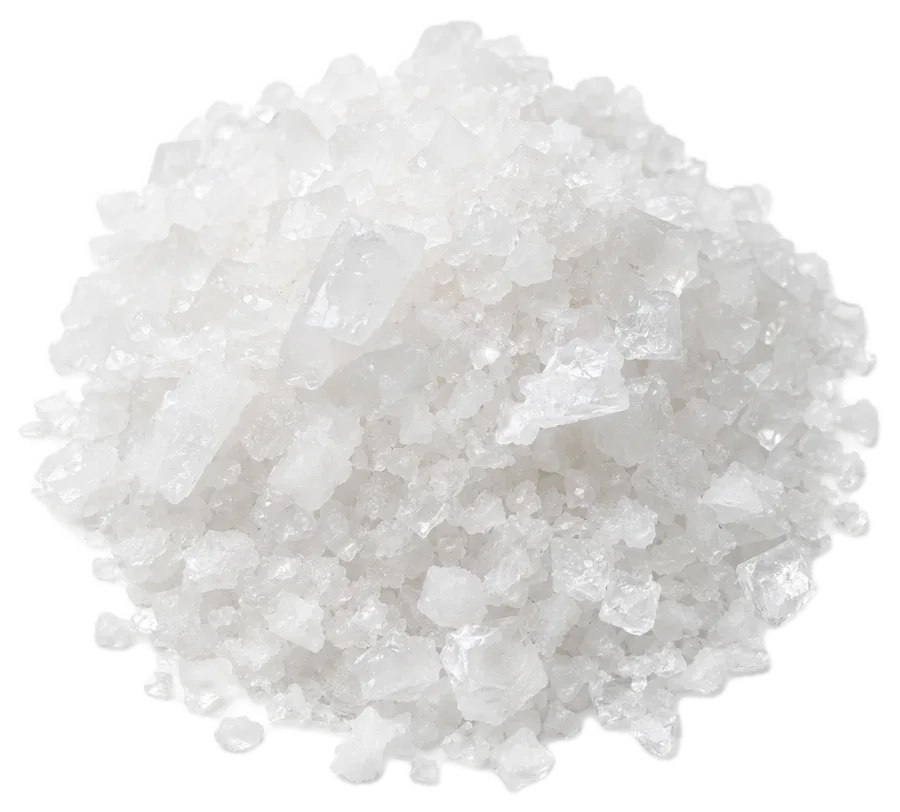
Mineral salts, meaning sodium chloride, potassium chloride, calcium chloride and magnesium sulfate, are simple salts that can help set a product's thickness
The short version
- Sodium chloride is table salt
- Calcium and potassium chloride are the calcium and potassium versions
- PubChem lists these salts for controlling thickness (viscosity).
- Magnesium sulfate: CIR found it safe as used, with reported leave-on use up to 11%
The good
- CIR found magnesium sulfate safe at assessed cosmetic uses and concentrations.5
- PubChem lists these salts for controlling formula thickness.1234
The not so good
- CIR's magnesium sulfate safety conclusion covers the uses and concentrations described in its assessment.5
The origin story
For mineral salts, one story starts with magnesium sulfate, or Epsom salts, extracted from spa waters at Epsom in England.67
Nehemiah Grew extracted the salts and studied their chemistry.68 In 1695, he published an account of his work.78 When he tried to patent their production and sale, he ended up in a dispute with the Moult brothers.68
What are these four salts?
The four mineral salts here are sodium chloride, potassium chloride, calcium chloride and magnesium sulfate.
Sodium chloride is table salt: sodium and chloride ions in a 1:1 ratio.1 Potassium chloride is the potassium version, white cubic crystals.2 Calcium chloride is a calcium and chlorine salt that dissolves easily in water and is deliquescent.3 Magnesium sulfate pairs magnesium with sulfate.4
What do these mineral salts do in a cosmetic?
Mineral salts like these can help a formula get the right thickness and body.1234
PubChem lists sodium chloride as viscosity controlling and bulking.1 Potassium chloride and calcium chloride are each listed as viscosity controlling.23 Magnesium sulfate gets hair conditioning, bulking and viscosity controlling.4
Are these mineral salts safe?
Magnesium sulfate has a safety review by the Cosmetic Ingredient Review panel.5
The Cosmetic Ingredient Review (CIR), a US expert panel, says it works as a bulking agent, is reportedly used at up to 11% in leave-on and 25% in rinse-off products, and is safe in cosmetics in the present practices of use and concentration.5 The panel also notes that its clinical experience, including numerous patch tests, indicates that "magnesium salts do not have the potential to induce sensitization."5
If a product irritates your skin, stop using it and check in with a dermatologist.
Questions people ask
Is sodium chloride in skincare just salt?
Yes, sodium chloride is the same compound as table salt, sodium and chloride ions in a 1:1 ratio.1 PubChem lists its cosmetic functions as viscosity controlling and bulking.1
What does magnesium sulfate do in cosmetics?
Magnesium sulfate works as a bulking agent, according to the Cosmetic Ingredient Review.5 PubChem also lists hair conditioning and viscosity controlling.4
Is magnesium sulfate safe in cosmetics?
Find it in
- revive & renew foot cream $14.99
Related ingredients
Back to the listSources
Show all 8 sources
- National Center for Biotechnology Information. PubChem Compound Summary for CID 5234, Sodium Chloride. National Library of Medicine, accessed 2026-11-22. Open source
- National Center for Biotechnology Information. PubChem Compound Summary for CID 4873, Potassium Chloride. National Library of Medicine, accessed 2026-11-22. Open source
- National Center for Biotechnology Information. PubChem Compound Summary for CID 5284359, Calcium Chloride. National Library of Medicine, accessed 2026-11-22. Open source
- National Center for Biotechnology Information. PubChem Compound Summary for CID 24083, Magnesium Sulfate. National Library of Medicine, accessed 2026-11-22. Open source
- Johnson W Jr, Bergfeld WF, Belsito DV, et al. Safety Assessment of Magnesium Sulfate as Used in Cosmetics. International Journal of Toxicology. 2018;37(1_suppl):47S-54S. Open source
- Sakula A. Doctor Nehemiah Grew (1641–1712) and the Epsom salts. Clio Medica. 1984;19(1–2):1–21. PMID: 6085985. Abstract retrieved through Europe PMC. Open source
- Childs PE. Epsom Salts. Chemistry in Action. 1993;40 (Summer). Reprinted in Wat On Earth, University of Waterloo, November 24, 2000. Open source
- Coley NG. “Cures without care”: “chymical physicians” and mineral waters in seventeenth-century English medicine. Medical History. 1979;23(2):191–214. doi:10.1017/S0025727300051371. Open source