































Eggplant fruit extract
Solanum Melongena (Eggplant) Fruit Extract
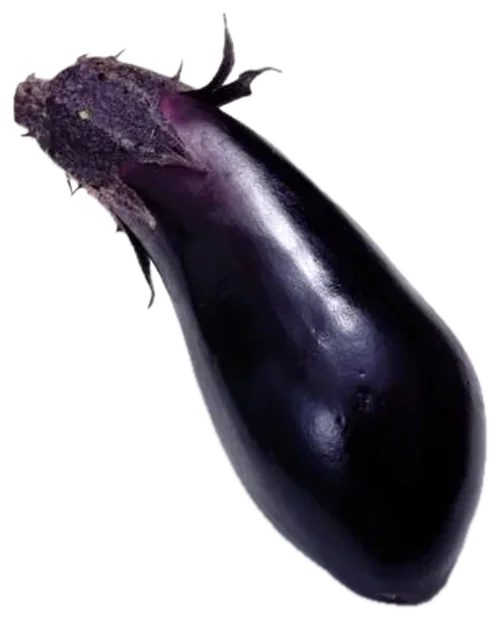
Eggplant fruit extract is an extract of the fruit of the eggplant, which the EU lists as a skin-conditioning ingredient
The short version
- Made from the fruit of the eggplant, Solanum melongena
- Its one official cosmetic job in the EU: skin conditioning
- Chlorogenic acid makes up 80 to 95% of the phenolic acids in eggplant flesh
- The purple peel gets its color from anthocyanins such as nasunin
- A patent reports a skin patch test in five men
The good
- The EU lists skin conditioning as its cosmetic function.1
The not so good
- The patent's patch test covered only five men and specific water eggplant preparations.5
- The CosIng entry lists no scientific safety committee opinion.1
The origin story
Eggplant fruit extract comes from the fruit of the eggplant, a crop people were already growing as a vegetable in China by the fourth century.4567
In 1753, Linnaeus published the plant's name, Solanum melongena, in Species Plantarum.89 By 2008, Japanese patents were proposing eggplant extracts for preparations applied to skin.510
What is eggplant fruit extract?
Yep, eggplant fruit extract comes from the vegetable.
The EU's cosmetic ingredient database defines it as an extract of the fruit of the eggplant, Solanum melongena, a member of the nightshade family (Solanaceae).1 The entry doesn't say how the extract has to be made.1
Eggplants come in a surprising range of shades, from white to lavender to nearly black. The color depends on how many anthocyanins, a group of plant pigments, sit in the peel.3
What's in an eggplant?
Chlorogenic acid is the standout compound in eggplant fruit.
Every study of the fruit's phenolic profile summed up in a 2023 review found it was the most abundant phenolic, and in cultivated eggplants it typically makes up 80 to 95% of the phenolic acids in the flesh.2 The review says the fruit's antioxidant capacity is attributed especially to that chlorogenic acid, and also to the anthocyanins in purple peel.2
Those peel pigments differ by type. Japanese eggplants tend to be rich in one called nasunin, while other types lean on delphinidin 3-rutinoside.3
One catch: the 80 to 95% figure describes phenolic acids in the fruit's flesh, measured by plant scientists, not the cosmetic extract.2
What does eggplant extract do for skin?
Officially, eggplant extract is a skin conditioning ingredient, and that's the only function the EU lists for it.1
Beyond that, the evidence runs out fast. A 2008 patent reports a skin patch test of water eggplant preparations in five men and a one-month cream test in 40 women.5 The fruit chemistry above is the starting point researchers would test, but a lab measurement on a vegetable isn't a result on a face.
Is eggplant fruit extract safe?
The CosIng entry for eggplant fruit extract lists no restrictions or scientific safety committee opinion.1
If your skin or lips react to a product with it, stop using it and check in with a dermatologist.
Questions people ask
What does eggplant extract do in skincare?
Eggplant extract has one cosmetic function listed in the EU: skin conditioning.1 A patent reports a skin patch test in five men and a one-month cream test in 40 women using water eggplant preparations.5
Is eggplant an antioxidant?
Eggplant fruit has antioxidant capacity, and a 2023 plant-science review links that to chlorogenic acid in the flesh and anthocyanins in the purple peel.2 That was measured in the fruit, not on skin.
What is nasunin in eggplant?
Eggplant's nasunin is the main anthocyanin, a purple plant pigment, in the peel of Japanese-type fruit.3
Find it in
- cocolicious luscious lip mask with bakuchiol $11.99
- cocolicious luscious lip scrub - bakuchiol $11.99
- the ultimate bakuchiol booster oil From $9.99
- the ultimate bakuchiol firming serum $19.99
- the ultimate snow shroom hyaluronic acid serum $17.99
Related ingredients
Back to the listSources
Show all 10 sources
- European Commission. CosIng cosmetic ingredient database: Solanum Melongena Fruit Extract. Open source
- Rosa-Martínez E, Bovy A, Plazas M, Tikunov Y, Prohens J, Pereira-Dias L. Genetics and breeding of phenolic content in tomato, eggplant and pepper fruits. Frontiers in Plant Science. 2023;14:1135237. Open source
- Cammareri M, Frary A, Frary A, Grandillo S. Genetic and Biotechnological Approaches to Improve Fruit Bioactive Content: A Focus on Eggplant and Tomato Anthocyanins. International Journal of Molecular Sciences. 2024;25(12):6811. Open source
- European Commission. First Update EU Inventory of ingredients employed in cosmetic products, section 1. June 9, 2000. Entry SOLANUM MELONGENA EXTRACT, last modification October 19, 1999. Open source
- Koizumi Y, Sawaki S, Sawaki S. Cosmetics. Japanese patent application JP2008069074A. Published March 27, 2008; filed September 12, 2006. Google Patents Japanese text and machine English translation. Open source
- Wang J-X, Gao T-G, Knapp S. Ancient Chinese Literature Reveals Pathways of Eggplant Domestication. Annals of Botany. 2008;102(6):891–897. doi:10.1093/aob/mcn179. Open source
- Daunay M-C, Janick J. History and Iconography of Eggplant. Chronica Horticulturae. 2007;47(3):16–22. International Society for Horticultural Science; author copy hosted by Purdue University. Open source
- International Plant Names Index. Solanum melongena L., Sp. Pl. 1:186 (1753). Name record 820053-1. Open source
- Manaaki Whenua—Landcare Research. Biota of New Zealand: Solanum melongena L. Scientific name record 71387413-700a-4e5d-bf0a-6d318b9dca08. Open source
- Miyahara R, Nakayama T, Kitamura K, Uehara K. Skin external preparation. Japanese patent application JPH03190809A. Published August 20, 1991. Google Patents Japanese text and English abstract/translation. Open source